by Chiara De Angelis | Giu 8, 2018
Credits: Picture by http://www.deia.com/2017/01/23/bizkaia/bilbao/
bilbao-pone-en-marcha-as-fabrik-para-consolidar-zorrotzaurre-como
-referente-en-industria-40-
| Country |
Spain |
| City |
Bilbao |
| Name |
AS-Fabrik |
| Date |
2017 |
| Description |
AS-FABRIK aims to shape a collaborative pilot Ecosystem for current or future workers of the KIBS sector (university students, entrepreneurs and professionals) so they can acquire the needed skills to attend the future demands of the manufacturing industry sector related with their digital transformation process.
As- Fabrik is structured around five pillars:
- New education programs for university students, entrepreneurs and professionals addressing the new challenges of the industry 4.0 and the digital economy.
- Networking actions among the main Stakeholders (local policy makers and policy experts, universities, entrepreneurs, KIBS companies and industrial sector) to ensure a good match between demand and supply, supported by tailored IT tools.
- Definition of new business models that cover the industry demands and specialized start-ups launching support.
- Minimum Viable Product (MVP) test Fab Lab for the market validation of new products/services.
- Physical and virtual Infrastructure to host the above mentioned items
These actions will position Bilbao as a specialized territory in the development of the Digital Economy and its firms as internationally first level suppliers of the manufacturing industry |
| Urban Co-Governance |
Moderate |
| Enabling State |
Moderate |
| Pooling |
Weak |
| Experimentalism |
Weak |
| Tech Justice |
Strong |
| Website |
http://www.uia-initiative.eu/en/uia-cities/bilbao |
| References, sources, contact person(s) |
http://www.uia-initiative.eu/en/uia-cities/bilbao
Contact :
Jordán Guardo Vazquez
Mayoral Advisor
Willem Van Winden
UIA expert
|
Bilbao

by Chiara De Angelis | Giu 8, 2018
Credits: picture by http://edition.cnn.com/2014/11/07/travel/south-africas-urban-farming-revolution/index.html
| Country |
South Africa |
| City |
Cape Town |
| Name |
Abalimi Community Garden Organization |
| Date |
1994 |
| Description of the project |
Abalimi is an urban agriculture (UA) and environmental action (EA) non profit association operating in the socio-economically neglected townships of Khayelitsha, Nyanga and surrounding areas on the Cape Flats, near Cape Town, South Africa.
They assist individuals, groups and community based organisations to initiate and maintain permanent organic food growing and nature conservation projects as the basis for sustainable lifestyles, self-help job creation, poverty alleviation and environmental renewal. Their core business is to assist their community to, firstly, combat poverty by growing food sustainably, using organic methods, at home and in community gardens and, secondly, to plant water wise indigenous trees and flora in schools and streets, in order to transform the dune-sands of the Cape Flats into a sustainable water-wise urban environment.
ABALIMI assists by providing the following support services:
Project implementation; agricultural and horticultural commodities; training; organisation building; facilitation of partnerships; research, monitoring and evaluation. |
| Urban Co-Governance |
Moderate |
| Enabling State |
Moderate |
| Pooling |
Moderate |
| Experimentalism |
Moderate |
| Tech Justice |
Weak |
| Project Website |
https://abalimibezekhaya.org.za/ |
| References, sources, contact person(s) |
Website : https://abalimibezekhaya.org.za/
Contact : https://abalimibezekhaya.org.za/contact/ |
cape town

by Chiara De Angelis | Giu 8, 2018
Credits: Picture by https://commonsjosaphat.wordpress.com/commons-josaphat/
| Country |
Belgium |
| City |
Brussels |
| Name |
Commons Josaphat |
| Date |
2015 |
| Description |
Commons Josaphat is an independent citizens platform that reunites neighbors, activists and associations. What links all these actors is the idea that the city can be governed like a common good.
They are mobilized to transform the Josaphat site (24 hectares) in a common space. In order to do this they have written a proposal to the Brussels Region, the owner of the contested land, where they propose concrete solutions on the organisation of this neighborhood.
The proposition and the organisation is the result of the work of two different working groups and a general assembly where decisions are taken all together.
The first working group, the ’atelier de « modélisation »” has designed a project for part of the site, including among its members representatives from a participatory school, a social housing, a cooperative, and an energy producer among others. The second working group instead, called “atelier usage temporaire”, tried to follow the principles of the Commons in order to temporarily make use of the site.
The proposal that sums up the community’s demands includes ideas on housing, sustainable mobility systems, planning of public spaces, the set up of services and commerces, institutions and infrastructures to promote culture and protect citizens’ health, zero or positive energy solutions, ecological measures to maintain the nature of the land of Josaphat and the constitution of transversal governance and decision-taking models. |
| Urban Co-Governance |
Moderate |
| Enabling State |
Moderate |
| Pooling |
Moderate |
| Experimentalism |
Moderate |
| Tech Justice |
Weak |
| Website |
https://commonsjosaphat.wordpress.com/commons-josaphat/ |
| References, sources, contact person(s) |
http://www.remixthecommons.org/en/2016/09/commons-josaphat-faire-la-ville-de-bruxelles-en-commun/
Contact : ideascommonsjosaphat@gmail.com |
Brussels

by Chiara De Angelis | Giu 8, 2018
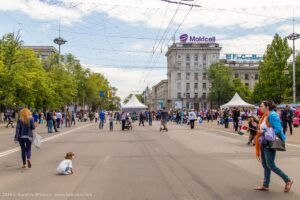 Credits: 2015 (C) Dumitru Brinzan - www.brinzan.com
| Country |
Moldova |
| City |
Chișinău |
| Name |
Public Space Days |
| Date |
The event in itself took place in 2016. |
| Description |
Public Spaces Days is an event organised by the Oberliht Association.
The Public Space Days provide a framework and space for discussion and action on public space. The event aims to highlight the importance of public spaces in our societies and to advocate for open, democratic and inclusive public spaces in our cities. Oberliht Association firmly believes that inclusive and open public spaces are crucial for building and fostering a democratic city in particular, and an inclusive and equal society in general. Moreover the Association recognizes that the public, open and democratic character of public spaces in our cities is currently under threat. The Public Space Days brings together activists, policy makers, artists, active citizens, scholars, architects and the general public in order to raise awareness on topics concerning protection, democratisation and opening of public spaces, to share insights and reflections on the transformations of public spaces, to share practices, ways of organising and collective action that foster and reproduce democratic public spaces. All events during Public Space Days are open and free for everyone to attend. The second edition of Public Space Days took place on September 2016. The edition of 2015 [realized with the support of ECF’s Connected Action for the Commons], did focus on the right to culture and the right to the city. |
| Urban Co-Governance |
Moderate |
| Enabling State |
Weak |
| Pooling |
Moderate |
| Experimentalism |
Moderate |
| Tech Justice |
N/A |
| Website |
APEL: Zilele Spațiului Public 2016 / ЗАЯВКА ДЛЯ УЧАСТИЯ: Дни Публичного Пространства 2016 | Zilele Spațiilor Culturale Alternative / 3-5 iunie 2022 (wordpress.com) |
| References, sources, contact person(s) |
Contact : info@oberliht.org
http://politicalcritique.org/connected-action/2016/pages-from-the-struggle-for-urban-commons-in-chisinau/
ECF Connected Action for the Commons’ Articles; http://www.culturalfoundation.eu/events/public-space-days-2016-in-chisinau-moldova |
chisinau

by Chiara De Angelis | Giu 8, 2018

Credit Image : screenshot 2022-22-04 from https://www.glasgow.gov.uk/CHttpHandler.ashx?id=52184&p=0
| Country |
United Kingdom |
| City |
Glasgow |
| Name |
Co-operative Glasgow |
| Date |
2012 |
| Description |
Glasgow had experience working in a cooperative way, so rather than simply delivering services it worked with enterprises and communities to co-create services designed around citizens’ needs. In 2012, the city made a commitment to become a ‘cooperative city’.
The projects is run by the Cooperative Development Unit (CDU) from the Glasgow City Council, set up to deliver the project’s action plan, identified two primary objectives: develop a new culture of partnership within the council, and help the city’s cooperative sector thrive and grow through easier access to funding and networking. The proposal led to the council establishing a £500,000 annual budget, and the expansion of the CDU. It also established a cross-functional group of ‘cooperative champions’, who identify cooperative opportunities and develop links within and beyond the council.
The council’s investment also enabled the Cooperative Glasgow Business Development Fund to be set up. This gives transformational business development grants to cooperatives, mutuals, social enterprises, and council departments. Since 2013, grants totalling £696,881 have been awarded to 34 existing cooperatives and 11 startups.
As with any project of this scale, Cooperative Glasgow has had its challenges. Establishing new kinds of partnerships with external organisations tested existing legal procedures and financially the public sector is naturally risk averse, which can inhibit the implementation of new ideas. It also recognised traditional business support didn’t include promotion of the cooperative business model: this was addressed by running workshops. The council intends to give Cooperative Glasgow the time it needs – and to future proof the project against elections and funding issues. |
| Urban Co-Governance |
Strong |
| Enabling State |
Strong |
| Pooling |
Moderate |
| Experimentalism |
Strong |
| Tech Justice |
Moderate |
| Website |
https://www.glasgow.gov.uk/index.aspx?articleid=17592 |
| References, sources, contact person(s) |
Institutional website of the City Council of Glasgow and online articles. Eurocities report at : http://www.eurocities.eu/eurocities/news/Cities-in-action-Glasgow-adopts-cooperative-model-WSPO-ALUFMU
Contact : Co-operativeBusinessDevelopmentFund@glasgow.gov.uk |
glasgow