by Chiara De Angelis | Giu 8, 2018
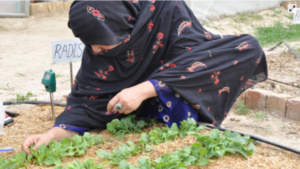
Image credit : http://participedia.net/en/cases/balochistan-agriculture-project-kitchen-gardening
| Country |
Pakistan |
| City |
Balochistan |
| Name |
Kitchen Gardening Initiative |
| Date |
NA |
| Description |
The Balochistan Agriculture Project is an initiative organized by USAID and UN’s Food and Agriculture Organization in Pakistan. The project’s primary aim is to help communities and individual farmers increase production, sales and revenues for crops and livestock. Another goal of the project is to inspire and facilitate the participation of women in income-earning activities.
Part of the project is the kitchen gardening initiative which empowers local women by teaching them how to harvest crops to feed their families. With this vital knowledge, families save more income on groceries and food and women are empowered to take care of their community, family and their own needs. Through this initiative, women are given an opportunity to improve family nutrition and incomes, even within the gendered constrictions within Balochistani society.
More than 500 women in three different districts were taught by other local women studying agriculture how to maintain kitchen gardens and how to preserve and process the fruits of their labour. The participants are both women from low income to no income families and the teachers are locally trained professionals from public universities. |
| Urban Co-Governance |
Moderate |
| Enabling State |
Weak |
| Pooling |
Moderate |
| Experimentalism |
Weak |
| Tech Justice |
Weak |
| Project Website |
http://participedia.net/en/cases/balochistan-agriculture-project-kitchen-gardening |
| References, sources, contact person(s) |
website |
Balochistan

by Chiara De Angelis | Giu 8, 2018
Image from http://scannewsnigeria.com/photo-news/at-a-town-hall-meeting-in-abuja/[/caption]
| Country |
Nigeria |
| City |
Abuja |
| Name |
Abuja Town Hall Meetings |
| Date |
2005 |
| Description |
In Abuja, Nigeria, a new democratic space was created to facilitate dialogue between political leaders in local government and citizens. Through the use of public meetings (town hall meetings) and a range of media, decision-making processes became more transparent and the scope for trust and mutual respect improved between citizens and the local government.
THMs were regular quarterly forums where all residents of Abuja could meet with the Minister and his team and raise matters of interest in a ‘no holds barred’ encounter. The THM was broadcast on radio and via a 30 minute television documentary afterwards. Over 1000 people attended the third THM, held in a suburb of the City Bwari. Many people in the community were formally invited to this event, some heard through word of mouth and others through advertisements on the radio. The participation of all six suburbs of Abuja was coordinated through the Area Council Chairpersons who helped organise the events and encouraged different categories of people to participate.
In addition to this, other communication initiatives were subsequently set up to strengthen the process and give feedback on the outcomes from the town hall meetings.
Dateline Abuja – an interactive phone-in and text-in radio programme run every fortnight on a Saturday morning on prime time national radio. A Helpline system – a series of public complaint phone numbers to process public complaints and provide feedback to the source. A team of energetic and passionate young people coordinated the helpline system. Some of them were fresh from University either on the mandatory one year of national service or fresh from service. A fact sheet of what worked well or otherwise according to feedback was circulated and taken as an integral part of memoranda to FCT executive committee. The FCT Executive Committee is the highest body responsible for policy decisions. Abuja Journal publication – an easy to read bi-monthly magazine for citizens with information about spending and policies and human interest stories. Intergenerational dialogues – with a focus on giving voice to children of primary and secondary school age. Boys and girls meet with the Minister of FCT and engage on policy matters in an informal interactive atmosphere. |
| Urban Co-Governance |
Moderate |
| Enabling State |
Moderate |
| Pooling |
Moderate |
| Experimentalism |
Moderate |
| Tech Justice |
Weak |
| Project Website |
http://participedia.net/en/cases/abuja-town-hall-meetings
http://participedia.net/sites/default/files/case-files/237_303_Case_Study_Nigeria.pdf |
| References, sources, contact, person(s) |
Participedia
For Abuja Municipal Council : mail@amacng.com |
Abuja

by Chiara De Angelis | Giu 8, 2018
 Credits: picture by http://www.smartaarhus.eu
| Country |
Denmark |
| City |
Aarhus |
| Name |
Smart City Aarhus |
| Date |
2010; officially launched in 2012 |
| Description of the project |
Smart Aarhus proposes a new way of organizing efforts to find effective and sustainable solutions to the challenges faced by many cities today. Through collaboration between the public and the private sector, citizens, the business community, and knowledge institutions, Smart Aarhus offers a platform for everyone, who wants to make use the opportunities of digitization across sectors and hierarchies.
Smart Aarhus addresses both technical and social problems. The city of Aarhus is integrating and synchronizing its systems for water, transportation, energy, healthcare, waste removal/recycling, and so on while simultaneously working on ways to improve the quality of life of its inhabitants. Second, Smart Aarhus has been designed according to a collaborative organizational model. Cities can only become smarter by fostering greater collaboration among policymakers, companies, entrepreneurs, and citizens. Smart Aarhus was established as a “collaborative community” within the Danish frame for smart cities as set by the Danish Ministry for Housing, Urban and Rural Affairs.
As far as governance is concerned, the initiative is overseen by a steering committee, including representatives from the local business community, research institutions, and the municipality. The Smart Aarhus secretariat works in close partnership with the municipality, Alexandra Institute, Aarhus University, and the Central Denmark Region as well as many different working groups, consisting of volunteers who work on challenges related to traffic, health, energy, culture, sustainability, and other areas. |
| Urban Co-Governance |
Moderate |
| Enabling State |
Strong |
| Pooling |
Strong |
| Experimentalism |
Strong |
| Tech Justice |
Weak |
| Project Website |
http://www.smartaarhus.eu/ |
| References, sources, contact person(s) |
Source: Snow, Hakonsson & Obel (2016) A smart city is a collaborative community: lessons from smart Aarhus, in California Management Review, 92-108
Interview
Contact :
Line Gerstran. Smart City Coordinator, Business and Sustainable Development, The City of Aarhus,
|
Aarhus

by Lucia Errandonea | Giu 8, 2018
 Image source : screenshot 04/2022 bristolapproach.org
| Country |
United Kingdom |
| City |
Bristol |
| Name |
The Bristol Approach |
| Date |
2016 |
| Description |
“The Bristol Approach to Citizen Sensing” is a project spearheaded by the Knowle West Media Centre in the city of Bristol that involves many community associations, artists, residents, and organizations in different neighborhoods. The project aims at creating a participatory urban commons framework, where citizens can work together with artists, activists and techies, to prototype sensor technologies that they actually need and want, and that could actually better their everyday lives. Indeed, the Bristol Approach tries to counteract a trend common to our cities today, which pushes for the development of smart devices that are often designed to be profitable. According to this project then, people and communities should be at the center of innovation in the city. Setting up a program for participatory sensing thus attempts at mapping the opinions, creative ideas, and needs of ordinary people, introducing technologies to citizens, which not only participate in designing new devices but also share the benefits of the common digital knowledge they create.
The ultimate goal of the Bristol Approach is the “creation of a new ‘urban commons’ where digital tools and data are used for the benefit of all”. |
| Urban Co-Governance |
Moderate |
| Enabling State |
Strong |
| Pooling |
Moderate |
| Experimentalism |
Moderate |
| Tech Justice |
N/A |
| Website |
The Bristol Approach – KWMC |
| References, sources, contact person(s) |
http://kwmc.org.uk/wp-content/uploads/2013/04/The_Bristol_Approach_artist_brief.pdf
http://bristolapproach.tumblr.com/
Contact : carolyn@kwmc.org.uk |
Bristol

by Lucia Errandonea | Giu 8, 2018
Image Source : https://www.quartiersmanagement-berlin.de/english/home-english-version.html
| Country |
Germany |
| City |
Berlin |
| Name |
”Social City” Initiative |
| Date |
1999 |
| Description of the project |
The Social City Initiative was born as a national project in order to support and provide help to communities in disadvantaged neighborhoods. The Initiative has been implemented in Berlin
through the Neighbourhood Management (NM) program. The strategy that lies at the heart of the NM program is one of participatory decision-making used as a tool for community
empowerment and socio-economic advancement. Involving residents in the decisions regarding their neighborhoods, the project set up “Neighborhood Councils”, which serve as an organizational framework to allow for discussion and consultation to happen among citizens. Thus, the idea the program wants to promote is that local citizens are the “experts” to be consulted first in decision-making processes, the ones that know best what are the issues to be solved. The program indeed wants to focus on communities’ social capital, giving them a voice in their neighborhood’s future, and a platform to exercise this voice together with their neighbors, in turn creating an opportunity for people to build a network. Thanks to this focus on community
building and empowerment, the program approaches socio-economic issues in an innovative way, proving that a strong local community is key for economic advancement.
The Councils therefore tackle problems of segregation and discrimination, lack of educational and working opportunities, service inadequacies, housing support, and revaluation of urban areas.
The funding comes from different sources: namely, from 1999 to 2015, the national government, the European Union and Land Berlin have allocated a total of 364 million euros that have been spent in the neighborhood management areas. |
| Urban Co-Governance |
Moderate |
| Enabling State |
Strong |
| Pooling |
Moderate |
| Experimentalism |
Strong |
| Tech Justice |
Weak |
| Project Website |
https://www.quartiersmanagement-berlin.de/english/home-english-version.html |
| References, sources, contact person(s) |
http://www.quartiersmanagement-berlin.de/english/program-social-city.html
https://www.quartiersmanagement-berlin.de/fileadmin/user_upload/SSE_Einlegeblatt_2S_2016_engl-WEB.pdf
anfangsplakat_english.psd (quartiersmanagement-berlin.de)Contact : https://www.quartiersmanagement-berlin.de/service/adressen.html#c3489 |
Berlin