by Francesca Spigarolo | Giu 8, 2018
Credits: © 2016 L'Observatoire
| Country |
Marocco |
| City |
Casablanca |
| Name |
Atelier de l’Observatoire, Art et Recherche |
| Date |
– |
| Description of the project |
The Atelier de l’Observatorie develops different projects in the area of Casablanca involving artists, students, researchers and institutions acting at local, regional and international level.
The Atelier experiments with alternative and participative approaches in the field of education ((MADRASSA), research (LES INVISIBLES), artist and culture (LA RUCHE). Additionally, it has activated different projects of urban regeneration and artistic participation in public spaces.
They created and manage the MUSEE COLLECTIF, a collective museum dedicated to the city’s memory, and they are engaged in a process to regenerate the ancient city aquarium, L’AQUARIUM, closed since 2007 ( and already partially closed since the 80s9 and recognized by the community as a space holding a strong collective value. The Atelier de l’Observatoire has also created an open and partecipative space called LA SERRE, dedicated to creating the conditions to necessary for cultural development and community building. La Serre is located in a rural area outside Casablanca, but since 2015 a mobile version of it has been created and placed in different urban locations, in order to engage the community in artistic processes and in reflections about art and culture.
The Atelier de l’Observatoire enjoys the support of the Moroccan Ministry of Culture, the French Embassy, the Institut Français, the Heinrich Boll Foundation and many other local actors.
Betwen the Atelier’s partners we find the Art Center “L’Usine” located in the Aïn Sebâa neighborhood of Casablanca. The ex-factory has been regenerated and transformed into a space dedicated to art and culture thanks to a process activated by the Fondation Chraïbi Abderrazik. In the new structure, together with the old machineries kept in place with the aim of preserving memory, it is possible to find an exhibition center, a printing atelier, a research laboratory and residence for artists. |
| Urban Co-Governance |
Moderate |
| Enabling State |
Weak |
| Pooling |
Moderate |
| Experimentalism |
Strong |
| Tech Justice |
Moderate |
| Project Website |
www.atelierobservatoire.com |
| References, sources, contact person(s) |
Website L’Atelier de l’Observatoire | L’association (atelierobservatoire.com) ; questionnaire
Contact : atelier.observatoire@gmail.com |
casablanca

by Chiara De Angelis | Giu 8, 2018

Image credit : http://redcomovamos.org/
| Country |
Columbia |
| City |
Bogotà |
| Name |
Red Colombiana de Ciudades, Cómo Vamos |
| Date |
1998 |
| Description |
In 1998 the Bogota Chamber of Commerce, the Editorial House El Tiempo and the Corona Foundation implemented the Bogotá Cómo Vamos project to evaluate the changes in the quality of life of the city through a follow-up to the fulfillment of the Development Plan.
After emerging in Bogota, this initiative expanded to other cities in Colombia, which together make up the Red Colombiana de Ciudades Cómo Vamos (RCCCV) where more than a third of the Colombian population lives. The RCCCV was born with the purpose of generating reliable, impartial and comparable information on quality of life, citizen participation and issues related to the city. The network also contributes to the development of effective and transparent governments, and creates more informed and responsible citizens.
Citizen control programs have also emerged at the sectoral level, such as Vamos Vamos en Salud and Educación Compromiso de Todos, promoted by the Corona Foundation, which has been replicated in other countries such as Brazil, Argentina, Chile and Peru. As a result of the RCCCV process, the Latin American Network for Fair, Democratic and Sustainable Cities and Territories was created at the continental level. |
| Urban Co-Governance |
Moderate |
| Enabling State |
Moderate |
| Pooling |
Moderate |
| Experimentalism |
Moderate |
| Tech Justice |
Moderate |
| Project Website |
http://redcomovamos.org/ |
| References, sources, contact person(s) |
Website
Facebook page : https://www.facebook.com/RedComoVamosCol
Contact : redcomovamos@gmail.com
|
bogotà

by Chiara De Angelis | Giu 8, 2018
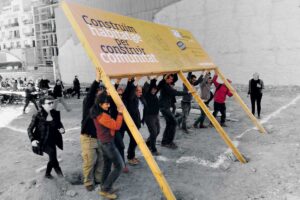 Image sources : https://www.syndikat.org/en/
| Country |
Germany |
| City |
Berlin |
| Name |
The Mietshäuser Syndikat (apartment-house syndicate) |
| Date |
1980s-90s |
| Description |
The goal of the Mietshäuser Syndikat, expressed in its 1992 statute, is ‘to support the genesis and achieve political acceptance of self-organized house projects – humane living space and a roof over the head, for everybody.’
The Mietshäuser Syndikat provides advice and support to self-organized house projects, so that they can be taken off the real estate market. With its know-how in the area of project financing it helps groups of residents interested in
living together in a self-organized and managed environment. Over the years the Syndakat has built a solid network, now composed of 119 house projects and 20 project initiatives. All these projects are autonomous and developed in different moments, but as they are part of a solidarity network, created and managed by the Syndakat, they work together and support each other.
All projects are self-organized, the Syndakat has a financial interest in every house-LLC to prevent sellouts (the financing and property system adopted is explained here), and all projects have committed themselves to making contributions to the joint solidarity fund. Therefore, older and more financially stable projects will support new projects by advertising them and participating in their financing. |
| Urban Co-Governance |
Moderate |
| Enabling State |
Moderate |
| Pooling |
Moderate |
| Experimentalism |
Strong |
| Tech Justice |
N/A |
| Website |
https://www.syndikat.org/en/ |
| References, sources, contact person(s) |
website : https://www.syndikat.org/en/
Contact : info@syndikat.org |
Berlin

by Chiara De Angelis | Giu 8, 2018
 Image source : https://www.allmende-kontor.de/
| Country |
Germany |
| City |
Berlin |
| Name |
Allmende Kontor (Commons Office) |
| Date |
2010 |
| Description |
Allmende Kontor is the name of both a community garden located in Berlin, in the area of the ex-airport Tempelhof, and of an association. The association, which created the garden and manages it, is also playing a fundamental role in the creation of a network of urban gardens and gardeners. The network is committed to the advocacy of a stronger support for urban gardening, which should become a common practice and should be recognized, regulated and facilitated also by policy makers. Allmende Kontor is calling for a paradigm change, both in policy making and in production and consumption behaviors, and is at the same working on community building and knowledge exchange. |
| Urban Co-Governance |
Moderate |
| Enabling State |
Moderate |
| Pooling |
Moderate |
| Experimentalism |
Weak |
| Tech Justice |
N/A |
| Website |
http://www.allmende-kontor.de/
http://thegardenedit.com/blogs/journal/17101096-allmende-kontor |
| References, sources, contact person(s) |
Websites
Contact : garten@allemende-kontor.de |
berlin

by Chiara De Angelis | Giu 8, 2018
Source: la Repubblica http://napoli.repubblica.it/cronaca/2016/01/02/news/il_comune_riconosce_l_ex_asilo_filangieri_tra_i_luoghi_della_cultura_di_napoli-130524954/
| Country |
Italy |
| City |
Naples |
| Name |
Recognizing the commons in Naples |
| Date |
2011 |
| Description |
The project begins in 2011, when the commons are included between the “purposes and fundamental values” of the Municipality’s Statute. Naples has been the first Italian city to devote an Administration’s department to the Common Goods. In 2012 the city’s Council established the “Laboratory for the Constituent on common goods” and in 2013 the Urban Permanent Observatory on the Commons was created.
The Administration has worked to individuate principles for “the identification and management of goods, unused or partly used, perceived by the community as “common goods” and subject to collective use” (expressed in Resolution n. 17, 18.01.2013), and has additionally focused on finding the principles for “the realization of actions directed to the inclusion of private good in the commons’ category. With this aim a Project Unit entitled “Identification and promotion of public and private spaces likely to be identified as the commons” has been created.
The identification of those principles allowed for the recognition (through a series of resolutions, with the last one being n. 466/2016) of seven public properties occupied by citizens and associations as “emerging commons and as civic developing environments”, and more spaces will be added to the list. The Administration recognized the value attributed to these spaces by the community, and decided to allow its citizens and social groups to directly manage them in a way that could “create social capital in terms of collective uses with a commons value”. One particularly interesting example is the Ex-Asilo Filangieri, the first good to be recognized as a commons. Already in 2012, the building was re-defined as “place with a complex use in the cultural field” (Resolution n. 11, 24/05/2012), with the aim of using its spaces to experiment with processes of participative democracy.
A narration of the Municipality’s path towards the creation of a new form of urban governance centered on the commons is available at this link (http://www.comune.napoli.it/flex/cm/pages/ServeBLOB.php/L/IT/IDPagina/16783), where all the official resolutions are also to be found. |
| Urban Co-Governance |
Moderate |
| Enabling State |
Strong |
| Pooling |
Strong |
| Experimentalism |
Weak |
| Tech Justice |
Weak |
| Website |
http://www.comune.napoli.it/flex/cm/pages/ServeBLOB.php/L/IT/IDPagina/16783 |
| References, sources, contact person(s) |
Recognizing the commons in Naples, Italy. Sources :
Comune di Napoli : http://www.comune.napoli.it/flex/cm/pages/ServeBLOB.php/L/IT/IDPagina/16783
European Alternatives : https://euroalter.com/2016/naples-common-good
L’Italia che cambia : http://www.italiachecambia.org/2016/08/napoli-immobili-comunali-occupati-diventano-beni-comuni/
Contact : fabio.pascape@comune.napoli.it |
Napoli