by Chiara De Angelis | Giu 8, 2018
 Credits: picture and logo from http://assoplanning.org/atelier-populaire-durbanisme-apu/
| Country |
France |
| City |
Grenoble |
| Name |
Ateliers Populaire d’Urbanisme and Urban Commons Working Group |
| Date |
2012 |
| Description of the project |
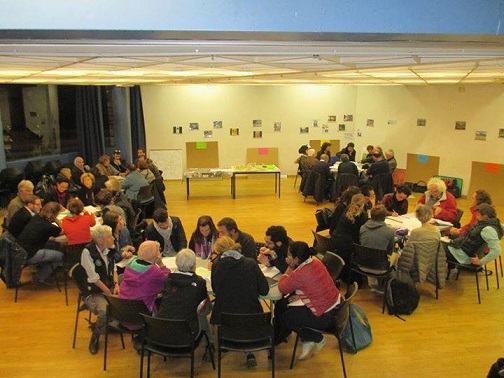
The Atelier Populaire d’Urbanisme de la Villeneuve is an initiative launched in the Fall of 2012 by a citizens movement in order to build an alternative urban regeneration project in Villeneuve in the city of Grenoble.
Organized as a big working group that gathers the inhabitants of the neighborhood, it was created as a result of the refusal of the top-down planning practices of the City of Grenoble.
In 2013, many workshops have started to formulate a new democratic urban project. In the following years, the Ateliers have continued fighting to stop a certain number of contracts and deliberations passed by the old local administration and to design a new vision for the neighborhood. The APU organizes Urban Commons Working Group.
Moreover, on an effort to co-build the neighborhood, the association has organized meetings every week in order to discuss about monthly thematic subjects concerning the new development (housing, environment, cultural and sport activities etc.). The Ateliers plays a central role still today in the fight for a more democratic urban planning. Through workshops, conferences, festivals, and mobilizations, it engages with citizens demands and empowers neighborhoods in the face of big development projects that do not take into account the citizens’ demands. |
| Urban Co-Governance |
Moderate |
| Enabling State |
Weak |
| Pooling |
Weak |
| Experimentalism |
Moderate |
| Tech Justice |
Moderate |
| Project Website |
http://assoplanning.org/atelier-populaire-durbanisme-apu/ |
| References, sources, contact person(s) |
Contact : planning@zaclys.net and Facebook page: https://www.facebook.com/APUvilleneuve/ |
Grenoble
by Chiara De Angelis | Giu 8, 2018
Image source : http://das-gaengeviertel.info/
| Country |
Germany |
| City |
Hamburg |
| Name |
Gängeviertel |
| Date |
2009 |
| Description |
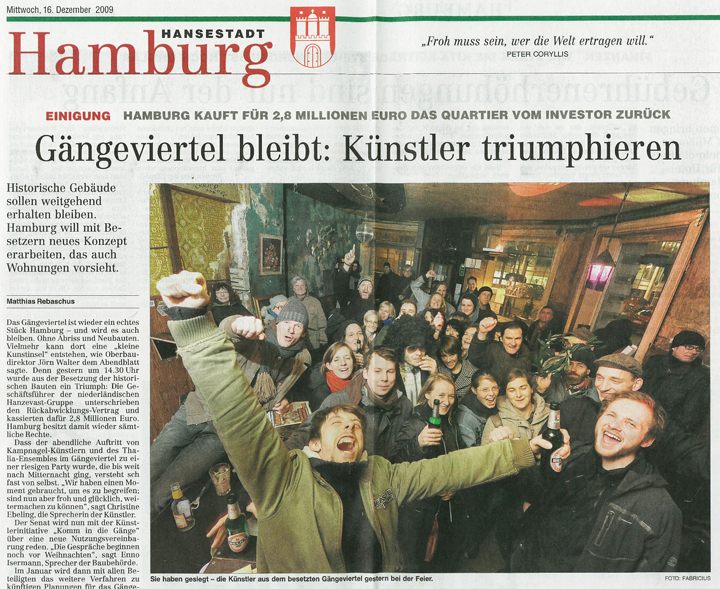
The Gängeviertel is a complex in inner city Hamburg composed of 12 buildings. Once workers housing left abandoned for years, the buildings were sold to leave space for a new development. Citizens and activists mobilized in August 2009 and entered the Gängeviertel in order to save it from decay and demolition, showing that another future for the inner city was possible.
In 2010, citizens presented a proposal for the redevelopment and usage of the area to the City of Hamburg and they have been negotiating ever since.
An Association of the Gängeviertel has been officially established and and through the “Komm in die Gänge” (get in your gears) Initiative the cooperative “Gängeviertel eG” has been founded for the conservation of this historic quarter, in order to secure the future of this area independently from political changes.
The inner city complex has been visited by tens of thousands tourists, artists, and activists from all over the world, who attend the art exhibitions, concerts, love readings, and discussion organized in the Gängeviertel.
The aim of the initiative is to create in Hamburg’s downtown an area for the promotion of the arts, culture, and talks, both in studios, in apartments, or in social projects. |
| Urban Co-Governance |
Moderate |
| Enabling State |
Strong |
| Pooling |
Moderate |
| Experimentalism |
Moderate |
| Tech Justice |
N/A |
| Website |
http://das-gaengeviertel.info/ |
| References, sources, contact person(s) |
Website
Contact : info@das-gaengeviertel.info |
hamburg

by Chiara De Angelis | Giu 8, 2018
 Image Credits: © Urban Mill
| Country |
Finland |
| City |
Helsinki |
| Name |
Urban Mill |
| Date |
2013 |
| Description |
Urban Mill is an incubator for urban innovations located in Aalto University campus, on the periphery of Helsinki, as part of the Smart City movement in the Metropolitan Region of Helsinki.
Opened in 2013, Urban Mill is a former factory transformed into a large co-working and co-creation space. This platform brings together local and international research labs and start-ups working on projects related to the built environment, the ubiquitous and responsive city, urban services and urban life transformation. Here, innovation actors collaborate, test their prototypes, present their projects and debate with citizens, meet potential investors and much more.
(https://citiesintransition.eu/place/urban-mill)
Urban Mill brings urban developers together with residents and other users of the urban environment. Public and private sector institutions, researchers, new entrepreneurs and students have a place to share ideas with the users of the built environment. Urban Mill is a venue for events and a smart co-working space for entrepreneurs and developers. Simultaneously, Urban Mill is an innovation accelerator that is connected to other spaces needed by the community.
How does it work and who participates?
The main partners of the program are the City of Espoo and Aalto University. A private company is responsible for developing the Urban Mill concept, operating the space and arranging the services. To give you some numbers, during the pilot phase 2013-2014, 25,000+ people participated in 1,000+ registered events; 5,000+ visitors from Finland and Abroad; 500+ pioneers participated in development; 300+ organisations and projects as users; 50+ proto/demo/startups through Living lab process.
All in all, Urban Mill operations have involved a total of more than 50 000 participants, 1500 events, 1000 users, 500 organizations. Urban Mill has helped to experiment 100 prototypes and to increase its 50 start-up companies. |
| Urban Co-Governance |
Moderate |
| Enabling State |
Strong |
| Poolism |
Strong |
| Experimentalism |
Moderate |
| tech Justice |
Moderate |
| Website |
https://urbanmill.org/
https://citiesintransition.eu/place/urban-mill |
| References, sources, contact person(s) |
https://citiesintransition.eu/place/urban-mill
Contact :
Kari Mikkelä, Ececutive Producer
kari.mikkela@urbanmill.fi
+358 50 500 4048
Lars Miikki, Producer
lars.miikki@urbanmill.fi
+358 40 503 6630 |
Helsinki

by Chiara De Angelis | Giu 8, 2018
 Logo source: https://ocupatucalle.com/
Image source : Arturo Diaz Quiroz, from https://ocupatucalle.com
Logo source: https://ocupatucalle.com/
Image source : Arturo Diaz Quiroz, from https://ocupatucalle.com
| Country |
Peru |
| City |
Lima |
| Name |
Ocupa tu calle |
| Date |
2014 |
| Description of the project |
Ocupa tu calle (Take over of your Street) is a strategy promoted by the Observatory Lima Cómo Vamos and supported by the AVINA Foundation that seeks to intervene the city by generating more and better public spaces that citizens can enjoy.
Through localized urban interventions, the project promotes the recovery of disused city spaces, the enhancement of existing spaces and the generation of new public places. Thus, through the implementation of parklets, pilot routes, cycle paths, temporary closures of streets and avenues or other interventions, not only a better city is achieved, but relations between citizens and the well-being of the community are fostered. |
| Urban Co-Governance |
Moderate |
| Enabling State |
Moderate |
| Pooling |
Moderate |
| Experimentalism |
Moderate |
| Tech Justice |
Weak |
| Project Website |
https://ocupatucalle.com/?utm_medium=website&utm_source=archdaily.com |
| References, sources, contact person(s) |
https://www.limacomovamos.org/ocupatucalle/
https://www.urbanagendaplatform.org/best-practice/ocupa-tu-calle
https://www.archdaily.com/969360/the-citizen-urbanism-claims-an-alternative-urban-model-from-latin-america-ocupa-tu-calles-lucia-nogales
Facebook page : https://www.facebook.com/OcupaTuCalle
Contact : hola@ocupatucalle.com |
Lima

by Chiara De Angelis | Giu 8, 2018

Credit image : http://codeforpakistan.org/
| Country |
Pakistan |
| City |
Islamabad |
| Name |
A Code for Pakistan Civic Innovation Lab |
| Date |
2016 |
| Description |
A Code for Pakistan Civic Innovation Lab is a group of volunteers who meet regularly to collaborate with government, non-profits and media organization on technology, data, policy and design projects that strengthen their communities. Every lab is led by a lab Manager who is responsible for building the community and maintaining the relationship between the Lab and the local partners. Lab members meet at least monthly; most CIL meet with greater frequency and have a range of monthly programming. All Labs are connected through an online forum in order to share stories and support each other’s work.
Labs are also closely coordinated with Code for Pakistan’s other programs: the Fellowship, the Accelerator, and the Peer Network. |
| Urban Co-Governance |
Weak |
| Enabling State |
Moderate |
| Pooling |
Strong |
| Experimentalism |
Strong |
| Tech Justice |
Strong |
| Website |
http://codeforpakistan.org/islamabad/ http://codeforpakistan.org/ |
| References, sources, contact person(s) |
Institutional websites
info@codeforpakistan.org |
islamabad