by Staff | Aug 15, 2019
Image credit : http://www.beirutmadinati.com/
| Country |
Lebanon |
| City |
Beirut |
| Name |
Beirut Madinati |
| Date |
2015 |
| Description of the project |
Beirut Madinati (BM) saw light in 2015 after a garbage crisis downtown. Facing inactive government, it formulated a policy: Municipal Solid Waste based on 4 R: Refusing certain products (straws and other thin plastic things), Reducing (consumption), Reusing, Recycling which received opposition from the municipality. NGOs and the nascent political political movement formed the “Waste Management Coalition”. The campaign is driven by the volunteers who are developing and testing “people centered programs”, in the Libanese capital.
Action Madinati Tafroz (means “my city will sort”) was launched by the waste management coalition with the idea was to select 15 appartments located in a representative congested, middle class neighborhood with a fair share of people who were not political and people attached to 2/3 political parties, and to survey how much waste they have. The entry point was to create a community and then spread the organization type to the city. More than 30 different people and several areas expressed interest and will to join the project. A manual was produced but did not produced the domino effect expected in the city and the process was thought through so as to be concretized.
Thus, Beirut Madinati was first a political campaign for the 2016 municipal elections and became a political movement led by volunteers from various backgrounds such as urban planning, transport engineering, waste management, economics.
This movement aims at building an alternative to the traditional political system in Beirut and it places livability at the heart of his program. The movement claims social, economic and political rights of the population whilst also preserving the environment and taking care of the cultural and natural heritage of Beirut. It has set up a 10 points municipal programme. |
| Urban Co-Governance |
Moderate |
| Enabling State |
Weak |
| Pooling |
Strong |
| Experimentalism |
Strong |
| Tech Justice |
Weak |
| Project Website |
http://www.beirutmadinati.com/ |
| References, sources, contact person(s) |
Interview; Website http://www.beirutmadinati.com/
Contact : contact@beirutmadinati.com |

by Staff | Aug 15, 2019
Credit : Screenshot from kumasihive.com – 11/04/2022
| Country |
Ghana |
| City |
Kumasi |
| Name |
Kumasi Hive |
| Date |
– |
| Description of the project |
Kumasi Hive is an Innovation and Entrepreneurship hub based in Kumasi (Ghana) which promotes “sustainable industrialization” by supporting local innovations and business/startups and therefore creating local manufacturing businesses for the advantage of the community.
The hub provides for co-working space, event space, training space, hardware studio as service and makerspace. It is meant to be scalable anywhere in the world and the structure already started to collaborate with organisations based in Kenya, Myanmar, and Nepal (Global Innovation Exhange, May 22. 2018) and in Senegal.
Concerning the organisation itself, two programs are active within the Hive.
- The Hive hardware incubator which incubates selected hardware startups, helping them move from idea stage through prototyping to product -for- market stage with both technical and business development support.
- And, the Hive Business accelerator program focuses on non-hardware startups program and is activate for the early stage startups.
Kumasi Hive is also connected to more common people, also working towards making resources available for the student community. In particular, Creativity Group is an undergraduate student community of engineers, makers, innovators, entrepreneurs and social thought leaders, eager to use innovation and technology as a tool to address critical challenges through social intervention and development of their communities. Eventually, Kumasi Hive believes in women empowerment; it indeed supported over 5000 women to start their business. |
| Urban Co-Governance |
Weak |
| Enabling State |
Moderate |
| Pooling |
Weak |
| Experimentalism |
Strong |
| Tech Justice |
Weak |
| Project Website |
https://kumasihive.com |
| References, sources, contact person(s) |
Website : Kumasi Hive | Home
Contact : info@kumasihive.com |

by Staff | Aug 15, 2019
Image source : https://map-action.com/logo-map-action/
| Country |
Mali |
| City |
Bamako |
| Name |
Map Action |
| Date |
– |
| Description of the project |
Map Action is a technological innovation initiated by Kaicedra-consulting, founded thanks to the Water Innovation Challenge II contest organized by VIA Water. It was presented at the 23rd international conference on climate change “COP23” in Bonn (Germany) as an innovative climate solution. Map Action represents a concrete response to the lack of reliable information for the knowledge and management of WASH problems (i.e. linked to low sanitation conditions, low health, untreated water, and therefore bad hygiene) as its first activity is to provide a map of Bamako with specific criteria, which lists the problems in the Hygiene and Sanitation Sector). In addition to the areas of WASH and the environment, the digital map is used in several sectors including: the agro-pastoral sector, the natural resources sector (Gas, Oil, Mines, …), forestry, infrastructure and equipment management. The project of Map Action emerged from the combination of several factors including (a) the lack of updated information in the field of water, sanitation and hygiene management, (b) the difficulty for citizens to report to the organizations or authorities conserned the WASH problems (c) the lack of coordination of the actions of the different actors. The organization follows the aim to integrate the population which plays a central role in communicating about local issues and participating to the mapping.
How does it work? The first step consists for citizens and field team to photography zones with local urban issues, using their phone. Identification and geo-localization of problems is the first key point. Once identified, the team of experts go on the field to carry out detailed studies measures. Following that, Map Action evaluates the impact on humans and on the environment and classifies the problem. To then propose solutions and measures to address the issue and provide people with strategies to anticipate inondations or to advise for waste management, for instance. A report is eventually sent to the competent authorities. |
| Urban Co-Governance |
Strong |
| Enabling State |
Weak |
| Pooling |
Moderate |
| Experimentalism |
Strong |
| Tech Justice |
Weak |
| Project Website |
https://map-action.com/ |
| References, sources, contact person(s) |
Contact : contact@map-action.com
Website : https://map-action.com/ |

by Staff | Aug 15, 2019
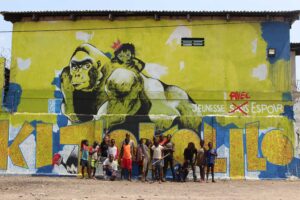
Image source : https://oyoprojects.com/
| Country |
Congo |
| City |
Kinshasa |
| Name |
Oyo Projects |
| Date |
2012 |
| Description of the project |
Oyo Projects is an association of artists, activists and other committed people that aim to heal and support street kids and young adults by engaging them in artistic and creative urban activities. Since 2012, the Oyo Project team works with street children in Kinshasa, the capital of the Democratic Republic of Congo. Through public exhibitions, street art and interventions, Oyo Projects raises awareness and encourages discussion, paying attention to giving equal voice to every child who suffer from exclusion from all common goods or activities if they don’t use violence, steel or beg for it. The association also provides meals, medicine and primary health care as well as a reliable contact person to listen to children and have an empathic and solidarity contact to grow up. The main principles are participation and collaboration. Specific projects including commoned painted murals encourage the children to appropriate places and the town to actively design their own city and the streets where they live. |
| Urban Co-Governance |
Strong |
| Enabling State |
Weak |
| Pooling |
Strong |
| Experimentalism |
Strong |
| Tech Justice |
Weak |
| Project Website |
https://oyoprojects.com/ |
| References, sources, contact person(s) |
Interview, Website : https://oyoprojects.com/
Contact : CONTACT@OYOPROJECTS.COM |

by Staff | Aug 15, 2019
 Image source: https://www.pepiniere.co/
| Country |
Canada |
| City |
Montréal |
| Name |
La Pépinière
|
| Date |
2014 |
| Description of the project |
The Pépinière is a non-profit aimed at giving more life to communities and making more participative cities. It uses public space to foster social relations as in former villages.
Its projects can be summarized in three main categories including the Vivace project, comprising a call for project and the deployment of the latter (in which the social distance between the project proactors and the neighbors was observed), and which was backed by the project managers and interns, the Laboratory sites which represent experimentation grounds and eventually the limited partnership with the municipality which is proactive towards federating communities.
All the projects are envisioned on the long-term and focus on giving tools for the community to get more autonomous. The projects are mainly implemented in Montreal, but also in Quebec where there are 2 projects, as well as in Toronto. Other small cities in rural areas have contacted la Pépinière less cosmopolitan. As an example, for the project “Rue de Dijon”, they fostered the creation of the “comité d’amis” through which they federated a nucleus of community around the project. |
| Urban Co-Governance |
Moderate |
| Enabling State |
Strong |
| Pooling |
Moderate |
| Experimentalism |
Strong |
| Tech Justice |
Weak |
| Project Website |
https://www.pepiniere.co/ |
| References, sources, contact person(s) |
interview, website
Contact : info@pepiniere.co |
Montréal