by Staff | Apr 11, 2022
 credits : www.facebook.com/lagosutopia/photos
| Country |
Nigeria |
| City |
Lagos |
| Name |
Utopia |
| Date |
– |
| Description of the project |
Utopia is an urban innovation group that wants to have an impact in emerging cities. The idea is to work on cities having a great pace of growth in population and infrastructure. The project wants to innovate and bring solutions. The idea is to create a new urban model, Utopia is based in San Francisco, but it operates in other cities like Katmandu and Rio. Utopia is establishing an urban innovation lab in Lagos, Nigeria. Lagos will become the largest city in the world this century and has become highly influential across the region (website).
Utopia wants to be a facilitator between the different actors of the city. It develops any kind of project that facilities solutions among many actors. Currently, we are working on an urban innovation challenge in Lagos. The idea is to connect entrepreneurs and startup with government bodies, basically saying -look we have an entrepreneur that has skills in data analysis, and you as a government body have that need..-On the ground, Utopia operates through partnerships, contacting different people, NGOs, services, presenting them what we can offer in terms of brokerage to help them frame their needs. We would go to the company or gov body: we say we are going to challenge a problem and ask what kind of issue would be beneficial to solve. The scope is to work on the entire metropolitan area of Lagos. The level works at the state level because Lagos is also a state. |
| Urban Co-Governance |
Strong |
| Enabling State |
Weak |
| Pooling |
Moderate |
| Experimentalism |
Strong |
| Tech Justice |
Weak |
| Project Website |
https://utopia.so/lagos |
| References, sources, contact person(s) |
Website (https://utopia.so/lagos) ; Interview
Contact : lagos@utopia.do |

by Staff | Apr 11, 2022
Credit : www.facebook.com/NdifunaUkwazi

| Country |
South Africa |
| City |
Cap Town |
| Name |
Ndifuna ukwazi |
| Date |
2011 |
| Description of the project |
“Founded in 2011, Ndifuna Ukwazi is an activist organisation and law centre that advocates for access to well-located land and affordable housing for poor and working class families, communities and social movements.
In our campaigns, we use a combination of community organising, research, advocacy and litigation to advance urban land justice and fuel systemic change. Our theory of change holds that leverage for social change is created by bringing together the use of the law, evidence-based research, media advocacy and, importantly, a movement of people. We believe that this convergence creates the right atmosphere for social change.” (Source : Website) |
| Urban Co-Governance |
Strong |
| Enabling State |
Moderate |
| Pooling |
Moderate |
| Experimentalism |
Moderate |
| Tech Justice |
Moderate |
| Project Website |
Website : https://nu.org.za/
Page Facebook : www.facebook.com/NdifunaUkwazi |
| References, sources, contact person(s) |
Website, Interview.
Contact : contact@nu.org.za |

by Staff | Apr 11, 2022

Image Source : https://surbanajurong.com/
| Country |
Rwanda |
| City |
Kigali |
| Name |
Kigali Matserplan (Surbana Jurong) |
| Date |
2013 |
| Description of the project |
The project is to update Kigali’s master plan, last approved in 2013, and renewed in 2015. Surbana Jurong updated the methodology of the plan. A phase of qualitative data collection leads them to create a vision of development for the city, a participatory process, an analysis of land use.
“The master plan transforms Kigali into a great city to live and work in by strategically guiding its development through optimal land use and facilitating rapid economic growth. Through the inclusive and participatory master plan, the city is positioned as a financial hub of east-central Africa to attract investments and create employment. Kigali’s development is characterised by a rejuvenation of the existing urban areas, transit-oriented growth, greater focus on affordable housing development in the suburban areas and the implementation of an attractive green network system.” (website)
The master plan is composed of a map with various layers in which they say how the land is used and then the technical implementation rules. There is also an implementation action plan, which establishes the stage of implementation of the plan, the stakeholders, the modalities, formation of a permanent assembly of stakeholders. When, what the priority, who is responsible, how much it will cost and physical elements.
All of this is available/will be available online, with simplified documents for non-technical people. In addition, for those who do not have access to the phone : citizens have access to tabacconists, which are trained, and who become an emanation of the public administration.
“Surbana Jurong’s master plan for Kigali City won the Best Overseas Planning Project Award 2010 and Best Planning Project 2013 in the Singapore Institute of Planners (SIP) Planning Awards.” (website) |
| Urban Co-Governance |
Strong |
| Enabling State |
Moderate |
| Pooling |
Weak |
| Experimentalism |
Moderate |
| Tech Justice |
Moderate |
| Project Website |
Kigali City Master Plan – Surbana Jurong Private Limited |
| References, sources, contact person(s) |
Interview, and website (Kigali City Master Plan – Surbana Jurong Private Limited)
kigalimasterplan2050@kigalicity.gov.rw |

by Staff | Aug 15, 2019
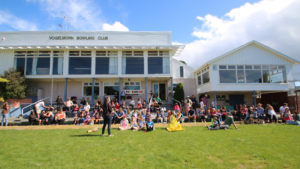
Image source : https://vogelmorn.nz/about/
| Country |
Australia |
| City |
Wellington |
| Name |
Vogelmorn |
| Date |
2015 |
| Description of the project |
“The Vogelmorn Community Group (VCG) is a charitable trust set up in 2015 which owns the land and buildings of a former bowling club. (The Hall and most of the adjacent Green are owned by Wellington City Council.) The buildings are available for rental to community groups and arts practitioners for workshops, rehearsals, classes and many other activities. VCG also organises events, or co-hosts them with other groups and individuals.” (Source : https://vogelmorn.nz/about/about/)
The Community Group of Vogelmorn Bowling Club is already ‘commoning’ with the space. In fact, the Vogelmorn Bowling Club has been owned and held for the use of the community, by a Community Trust since 2016. Working bees and fund raisers are held to improve the income for the payment of electricity, maintenances, etc.
Affordable rental of the club is via booking at www.vogelmorn.nz |
| Urban Co-Governance |
Moderate |
| Enabling State |
Moderate |
| Pooling |
Strong |
| Experimentalism |
Strong |
| Tech Justice |
Strong |
| Project Website |
https://vogelmorn.nz/about/about/ |
| References, sources, contact person(s) |
Jeremy Macey and Sophie Jerram, Trustees of the Vogelmorn Community Group
Sophie Jerram is working with the Vogelmorn Community as a practice-led researcher toward a PhD on spatial commoning supported by the University of Copenhagen and Victoria University of Wellington
Contact : vogelmornbc@gmail.com |

by Staff | Aug 15, 2019
 Image source : https://www.visitdenmark.it/danimarca/pianifica-il-viaggio/orestad-gdk957608
| Country |
Denmark |
| City |
Copenhagen |
| Name |
Orestad district |
| Date |
– |
| Description of the project |
The district of Orestad in Copenhagen, situated on Amager Island was partially made up as an experiment and a showcase for new and sustainable nordic architecture. Its plan, realized by the ARKKI company was comprising four mini-districts with dense habitation straddled by two canals and separated by green areas(Andrew Mellor, “Smart City” of the past, present and future). Although the first decade of the project focused on the construction of offices (Stan Majoor, 2015), the results did not reach the expectations neither in terms of quality nor in terms of quantity. Also, in the second decade, even if the district was designed to host numerous residential building such as the VM Mountains and benefitted from good public transportation, it did not manage to attract as many people. In great part because of the Housing crisis (Stan Majoor, 2015), that led to a drop in housing prices in Copenhagen and left the buyers of the unbuilt plots without much chance of getting developing proposals. Besides, and still because of the financial crisis, the development company found itself pressured to devaluate the value of their still unsold land and extend their debt repayment periods (By & Havn, 2013). The planning crisis was amplified by the increasing competitive environment and coincided with the dissolution of the Ørestad Development Corporation (ODC) and the set up of the CDP company allowing for a new management in particular with sub-departments allowing for bottom-up activities and specific tasks (Stan Majoor, 2015). |
| Urban Co-Governance |
Moderate |
| Enabling State |
Strong |
| Pooling |
Weak |
| Experimentalism |
Moderate |
| Tech Justice |
Weak |
| Project Website |
– |
| References, sources, contact person(s) |
Article by Andrew Mellor, scientific literature |
Copenhagen