The Reading House Community

The Reading House Community
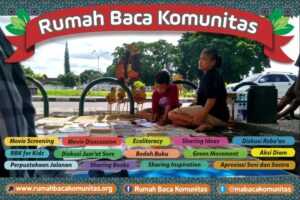
Image source : https://rumahbacakomunitas.org/

Country Indonesia
City Yogyakarta
Name The Reading House Community
Date 2016
Description of the project The Reading House Community (RBK) is a library community that was opened by 6 or 7 people in 2016; the group formed with a common interest in books: the community is a charity movement to distribute books to increase literacy level in Yogyakarta. The founders shared the same passion in reading and same consciousness; they were aware that Indonesia, according to Unesco, was among the countries reading less.  They decided to gather the book they had, and bring all the books to one place.

The idea is a library based on trust. The location is a house rented annually, the real core of the community, where activities for kids are carried out. Reading session for kids and classes. There are regular discussions open to the public.

RBK goes weekly to a public space where books are put on the ground, offering street food, and letting people come or borrow the books without asking for an ID card, telephone number, and no date for return. It is a project based on trust. People bring more books back or friends.

It has been four years that the Reading House Community is doing this almost every week to improve literacy levels in Indonesia.  

Urban Co-Governance Weak
Enabling State Moderate
Pooling Strong
Experimentalism Moderate
Tech Justice Weak
Project Website https://rumahbacakomunitas.org/
References, sources, contact person(s) Interview ;

Contact : rumahbacakomunitas@yahoo.com

Kota Kita

Kota Kita

Image source : https://kotakita.org/

Country Indonesia
City Banjarmasin
Name Kota Kita
Date 2010
Description of the project Kota Kita works as an advocacy project to make the city more inclusive. They run a set of micro-projects and collaborators that are based on co-design of public space, for example one is creating a safe school. They aim to increase the local kind of dynamics in terms of civic engagement, with young people.

Kota Kita collaborates to build capacity and to activate the urban movement in the city. The project is based on sociologists, architects, social activists, archeologists… (interview)

They “provide public access to resources and knowledge to encourage collaboration, promote new ideas, and mobilize community support.” (Website)

Urban Co-Governance Strong
Enabling State Strong
Pooling Strong
Experimentalism Strong
Tech Justice Weak
Project Website https://kotakita.org/
References, sources, contact person(s) Interview ;

Contact : info@kotakita.org

Kolektif Agora

Kolektif Agora

Credit Image : https://medium.com/kolektif-agora

Country Indonesia
City Bandung
Name Kolektif Agora
Date  2017
Description of the project “A collective literacy space to explore urban narratives. Talk, word by word.” (Facebook page)

The initiative believes taht people are inclined to do better for our cities if they have more choices, if they know that there are more choices. They started with transportation, and now try to extract knowledge from academic paper, book, reality and transform it to make it more simple to citizens. The Kolektif see itself as a community mediator, which transform knowledge into easier stories so that citizens can do better. It is a NGO but with no legal form, communities within the project are free to do whatever they want. 

Urban Co-Governance Moderate
Enabling State Moderate
Pooling Moderate
Experimentalism Strong
Tech Justice Strong
Project Website https://medium.com/kolektif-agora and their Facebook page : Kolektif Agora | Facebook
References, sources, contact person(s) https://www.facebook.com/kolektif.agora

Interview

Contact : kolektif.agora@gmail.com

Utopia – Kathmandu

Utopia – Kathmandu

Image credit : Kathmandu Studio — Utopia

Country Nepal
City Kathmandu
Name Utopia – Kathmandu
Date
Description of the project

    Utopia is creating a network of CITYLabs across Africa, Asia, and Latin America to build the ecosystem foremerging cities and their slums. Each CITYLab collaborates with entrepreneurs of the city to found and grow urbanstartups. The idea is to create a new urban model, that even if it based in San Francisco, operates in other citiesworldwide like Lagos and Rio. In each city, their model involves the creation of a venture studio to create newstartups, a fund to finance the venture, and a hub that createsevents to share knowledge and networking.

Currently, in Kathmandu, Utopia is installing its Urban Innovation Lab, and working on two streams. While working on the fund, they are building its physical space, and Urban Laboratory based in Katmandu, the team does research on identifying potential challenges for slum development.One venture is on waste, to bypass and classify a majority of materials as garbage due to an under developed recycling system (and network). The venture wants to redesign and business/supply chain models in recycling andproduct development. A second venture is on urban migration to help the many migrants arriving early on, to fosternetwork building, enhances their employability, and connects them to the market.

Urban Co-Governance Strong
Enabling State Weak
Pooling Strong
Experimentalism Strong
Tech Justice Weak
Project Website https://utopia.so/k02/td
References, sources, contact person(s) Interview with a staff member

Contact : kathmandu@utopia.so

Innovative solutions to sanitation problems in urban slums – SHWAAS

Innovative solutions to sanitation problems in urban slums – SHWAAS

Credit Image : chfindiafoundation.org

Country India
City Pune (Maharashtra)
Name Innovative solutions to sanitation problems in urban slums – SHWAAS
Date 2012 (May)
Description of the project Project SHWAAS has three main components: the renovation and construction of community toilets, community mobilisation and involvement in sanitation issues, and capacity building of local government officials. In partnership with the Pune Municipal Corporation (PMC), CHF aimed to implement the project in 100 slums in Pune, though rebuilding of toilets was not prioritised for all slums. The municipal corporation was responsible for building community toilets, while CHF led community mobilisation and capacity building. Eight staff members from CHF worked on SHWAAS, with an additional six officials from the PMC. 

Besides, CHF sees heavy involvement from the community in creating, implementing and evaluating the project as the only way to ensure long-term sustainability of any sanitation efforts. Social workers from CHF worked in the selected slums to create Shwaas Samities, Health Committees with 6-10 members.

Urban Co-Governance Strong
Enabling State Strong
Pooling Moderate
Experimentalism Weak
Tech Justice Weak
Project Website http://www.chfindiafoundation.org/
References, sources, contact person(s) Source : annual reports published by CHF India Foundation (http://www.chfindiafoundation.org/) as success-story-1.pdf (chfindiafoundation.org); interview with CHF Director

Contact :  info@chfindiafoundation.org