by benedictaquarcoo | May 20, 2023 | Blog, Commons Magazine, Publications
The second chapter of the Co-city book is initiated by recalling Elinor Ostrom’s revolutionary studies of natural resource commons (Ostrom 1990), posing the question:
Are there groups of residents and/or resource users who are willing and able to organize themselves, work together to establish rules for sharing resources, and monitor themselves in the absence of external authority or externally imposed regulations?
The definite answer given by the authors of the Co-cities book is yes, considering the several empirical analysis and observations conducted in about 200 cities across the globe. This is reflected in many forms: from simple community mesh wireless networks to urban villages or parks. Usually, organized community groups or associations of users and or residents come together to manage and or co-create community resources.
The writers go ahead to apply Ostrom’s analytical framework to urban resources in cities. Ostrom’s design principles are seen to be most relevant in the management of many kinds of public and shared resources in a city but Foster and Iaione give evidence according to which these principles may not work in the exact same way outside the city.
Thus, chapter 2 offshoots Ostrom in the City.
OSTROM IN THE CITY
This part exposes readers to how much Ostrom’s design principles and observations are either applicable, of limited utility, or need to be modified to the current urban context. Instances such as community size and cohesion, shared social norms, social capital, community homogeneity, the scale of resources, and the recognition and support of central authorities and external actors all play a significant role in a community’s capacity to manage a shared resource collectively and sustainably over time.
It is quite significant, for example, to not undermine or disregard the role of central authority in the creation and sustainability of the urban commons. Since the State cannot be disregarded in the management and regulation of urban resources, sometimes collective natural resources demand a certain level of legal and property modification. Thus, a larger group of urban residents, many of whom are on the social and economic periphery of expanding cities gain access to these services. The benefit of the State’s effort to bridge the gap between the marginalized and the elite is partly bridged.
GOVERNING GREEN URBAN COMMONS
Another example regards “Urban Green Commons”, whose management considers them as urban ecological resources, such as lakes or urban parks. They are meant to promote social integration and enhance social networks in crowded, diverse, and frequently socially stratified metropolitan contexts. As much as they are beneficial to residents, they tend to be vulnerable and one way to tackle it is through collective action.
For instance, quoting: “Ostrom’s framework for the study of the commons in cities has been applied by researchers who have looked at ecological resources like lakes, rivers, and forests that urban local communities use for traditional cultural and economic uses and/or recent urban migrants use for aesthetic and recreational purposes” (D’Souza and Nagendra 2011).
ENABLING URBAN COMMONS
The following section focuses on all levels of support from the various actors and how their roles are significant to the management of urban commons. These kinds of cooperation take the legal or institutional form of agreements or partnerships between local government and the association of residents that have set up an asset, for instance, agreements like the one between the city of New York and the Central Park Conservancy serve to formalize the parameters of the conservancy’s responsibility for the day-to-day management of the park as well as to establish important norms regarding the limits of the group’s responsibility for the resource, such as reverse crowd-out protection that ensures public funds won’t be replaced by private donations.
Despite strong social links and cooperative activities, these efforts might not be successful or long-lasting if local, but also central, governments and their programs.
Other forms of enabling thus include partnerships between local businesses, property owners, and local governments established to manage the neighborhood commons, special institutions arrangements, hence, in most cases, public-private partnerships.
BOTTOM-UP VERSUS TOP-DOWN URBAN COMMONS
A top-down, institutionalized, state-enabled form of collective resource governance is initiated and comes into being only through government authority or action, especially in cases such as large park conservancies and BIDs. Yet for most urban commons, a bottom-up approach is used and as such needed, and these initiatives are made by locals or resource users who are driven to work together to create new goods and services that many urban areas lack or find inaccessible to overcome traditional collective action challenges. Citizens and community-led associations and groups identify opportunities within the community such as vacant land spaces, abandoned parks, and forest reserves. They then ensure that the local government’s attention is drawn to this. The bottom-up approach, fostering what is called public-private-community partnership, comes with challenges but is appropriate for the urban commons and encourages both collective action and an enabling State.
COMMONING IN THE CITY
This part characterizes commoning as a bottom-up technique of cooperatively generating or constructing resources that can be shared with others and that satisfy precise user needs. Commoning patterns and practices vary naturally based on the resource, the type of user community, and the social or cultural context. Both a resource and a community are requisite in this case to co-manage, steward, and cater for assets and services over a longer period.
LEGAL AND PROPERTY ADAPTATION
Indeed, the enterprise is not easy.
The cost and accessibility of urban land and infrastructure are noted as what precisely makes the development of new types of shared and jointly managed urban products hard. Legal and Property adaptation exposes how urban communities and “commoners” are striving to change the legal status of the land and structures they use and/or occupy to take ownership of them. Alternative solutions are available, for example by using legal and property tools such as community land trusts (CLTs) or limited equity cooperatives (LECs). CLTs are created to enable communities to self-govern and care for urban land and structures, keeping them accessible and affordable for future users. Gray, 2008 states that the essence of land trusts is to promote affordable home ownership and local control of the land. The International Community of Economics (ICE) describes CLTs as a private nonprofit corporation established to purchase and keep land for the benefit of a community and to provide community inhabitants with safe, affordable access to land and homes. CLTs can scale through networking with the support of local policies and public resources. The intent is to protect the community at a neighborhood level: nested urban commons.
CONCLUSION
This last portion of the second chapter is dedicated to numerous examples of community land trusts, how they work, when they were initiated, and the numerous benefits it has had on the residents in various parts of the US. This signifies that there are communities that have the capacity to organize, co-create, co-share, and co-produce assets and services that are beneficial to them. They also act as stewards to safeguard and protect these social amenities through the zeal of ownership. The bottom-up approach establishes the concept of the commons considering its participatory approach and collective action by all stakeholders. The legal factor is also upheld where necessary according to the context of the society or community. The pursuit of urban commons transcends theory.
Short References
Bunce, Mel. (2015). International news and the image of Africa: New storytellers, new narratives?
D’Souza R, Nagendra H. Changes in public commons as a consequence of urbanization: the Agara lake in Bangalore, India. Environ Manage. 2011 May;47(5):840-50. doi: 10.1007/s00267-011-9658-8. Epub 2011 Mar 23. PMID: 21431444.
Institute for Community Economics. (1982). The Community land trust handbook.
Emmaus, Pennsylvania: Rodale Press
Gray, Karen. (2008). Community Land Trusts in the United States. Journal of Community Practice. 16. 65-78. 10.1080/10705420801977999.

by Valeria Lembo | Apr 7, 2023 | Blog, Publications
Sheila R. Foster and Christian Iaione have been recently guests of David Bollier on his podcast “Frontiers of Commoning” (episode 37). The interview was an opportunity to present their last publication, “Co-Cities: Innovative Transitions Toward Just and Self-Sustaining Communities”, discussing the recent developments of their studies and remembering previous achievements. In this regard, it was very interesting to hear about the “Bologna Regulation for the Care and Regeneration of Urban Commons”, a formal legal and bureaucratic system for coordinating citizen collaboration with the city government, developed by professor Iaione.
Leveraging citizen energies coordinating it in an horizontal relationship with governments, civic and private players and knowledge institutions is also the core principle of “LabGov – the Laboratory for the Governance of the City as a Commons, which in Bollier’s opinion represents a virtuous example of a new form of civic collaboration.
Different urban settings lead to different possible ways to build urban commons, this was the following topic discussed, this meaning that taking into account the specific uniqueness of every urban context is the only way to create a socially balanced and inclusive contest. A larger conceptual able to embrace different histories and personalities, which Foster and Iaione call “co-city protocol”: knowing, mapping, practicing, prototyping, testing, and modelling are its elements.
Iaione particularly stressed out the point of testing affirming that despite failure is always behind the corner in this type of projects, it doesn’t have to be a brake but an incentive. In fact, failure in the end has led to the “neighborhood-based energy co-ops” in Italy and elsewhere in Europe, giving communities a crucial role in the decision making process about energy production and distribution.
At this link you can find the podcast conversation:
https://david-bollier.simplecast.com/episodes/christian-iaione-sheila-foster-on-urban-commoning-initiatives
And here you can find a blog on the conversation, by David Bollier:
https://www.bollier.org/blog/foster-iaione-probe-commoning-city

by Valeria Lembo | Apr 7, 2023 | Blog, Publications
“Co-management city assets to improve the quality of democracy” – included within the report “A look at democratic experiments across Europe.”
Luiss professor Iaione calls “administrative collaborative democracy” the idea to establish civic collaborations with local communities, governments, businesses, academics and NGOs.
European cities and their residents are increasingly using collaborative tools which allow inhabitants to participate in the design and management of city assets, a practice which, according to experts, can create more democratic societies and markets.
The aim is to involve residents in the decision-making process and management of city assets or urban commons: “it’s not about just participating in local governments, but it’s about sharing the management of and co-owning the services and assets with city inhabitants.”
Turin’s Bee Ozanam, once a factory, has been turned into a multi-purpose building, comprising also a temporary house for migrants, a restaurant run by disadvantaged workers and a rooftop community garden. This example is the result of community initiatives aiming to regenerate the place. The regeneration process was funded through the ” Co-City” project, under the EU Urban Innovative Action programme.
The aim of the project was to promote collaboration between the local administration and citizens for the shared management and regeneration of urban commons.
We want to thank Silvia Ellena of Euractive for the interview.
Below is the link to read the full article:
Co-managing city assets to improve the quality of democracy

by Valeria Lembo | Apr 7, 2023 | Blog, Publications
This article discusses the concept of Urban Sustainable Development and Innovation Partnerships (USDIPs) as a tool for designing and managing policy experiments in cities to accelerate technological and ecological transitions while ensuring accountability and equality among stakeholders. The article examines inclusive and innovative forms of public-private partnerships, urban co-governance, and citizen science in the context of global and European policy initiatives. The EU Urban Innovative Actions Initiative and the “UIA Co-City Turin” project are used as a case study to demonstrate the effectiveness of USDIPs in promoting sustainable development.
The article identifies four key tools that are instrumental in creating USDIPs:
- innovation procurement;
- social and sustainable finance planning;
- digital tools for multistakeholder cooperation;
- investment in capacity building
The article calls for concrete policy action at the EU level to use USDIPs to bridge the gap between different policy agendas related to sustainable development in cities.
Click on the links below to read more about this article.
Urban sustainable development and innovation partnerships
by Valeria Lembo | Apr 7, 2023 | Blog, Publications
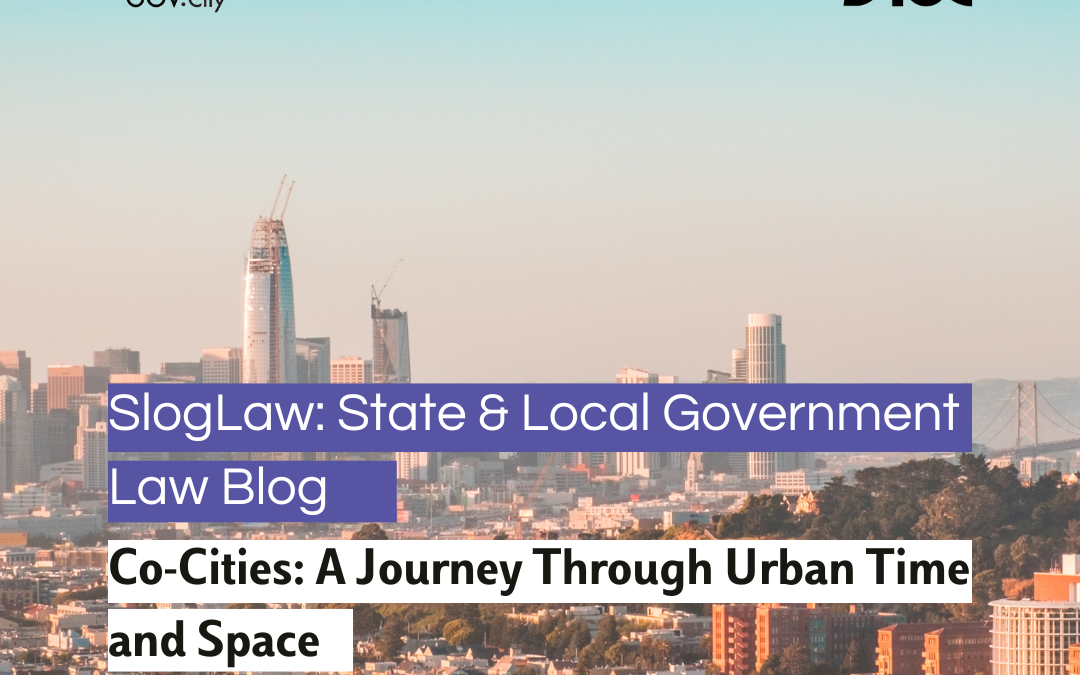
Many scholars, experts, authors and policymakers have expressed their opinions about Cities and Urbanism today on Sloglaw. Amnon Lehavi, Professor of Law at the Harry Ledzyner Law School, Reichman University also shares his thought-provoking opinions on Sloglaw about the Co-cities book authored by Professors Sheila Foster and Christian Iaione.
He shares how beneficial the co-city framework has been to his hometown, Tel Aviv and how useful this framework will be to other cities in the world.
Professor Lehavi believes that this book: Co-cities has taken an essential journey through space and time. He shares that the co-city framework will help cities be transformed no matter the challenges: be it social crises, financial or economic crises and the many urban issues that come up in cities today.
To read more of this, find below the link and join the urban and city conversation. Don’t forget to share your thoughts. We welcome them and we love to hear what you think.
https://www.sloglaw.org/post/co-cities-a-journey-through-urban-time-and-space
Click on the links below to read more about what other authors are saying about Co-cities.
https://www.sloglaw.org/post/co-cities-reconceiving-the-city-the-commons-and-new-governance-theory
https://www.sloglaw.org/post/does-urban-co-governance-change-the-urban-co-governors
https://www.sloglaw.org/post/from-and-to-natural-resources
by benedictaquarcoo | Mar 22, 2023 | Blog, Commons Magazine, Publications
What key principles underpin a Co-city model of urban governance, and how can they be applied to promote more collaborative and inclusive approaches to urban planning and development?
Following our previous discussion which introduced the book, this session brings us to comprehend the first chapter. Entitled “Rethinking the City”, the chapter capitalizes on Polycentrism and the Quintuple Helix Approach for approaching governance issues (public, community, civic, knowledge, and private). It sets the stage for the book’s exploration of how cities can become more collaborative and inclusive in their governance structures. In response, the writers advocate for a new model of urban governance that is more participatory, bottom-up, and collaborative.
First off, the chapter outlines immersion and provides examples of the various synergies by residents of communities, emphasizing the efforts and challenges they put into co-create, co-produce, and co-share a common good or resource. This is done by the application of innovative, skillful techniques and mechanisms leading to a total transformation of the common good. The created resource is not left as a stand-alone project but then each member who contributed towards it, one way or the other feels a sense of belonging. This is where the concept of stewardship is introduced “Resident transformation of previously vacant lots into community gardens represents a form of local environmental stewardship” (pg.34). Building on the concept of environmental stewardship as provided by the Aarhus Convention, the section explains local environmental stewardship as a course of action taken by individuals, groups, or networks of actors, with various motivations, to protect, care for, or responsibly use valuable or scarce resources in pursuit of environmental and/or social outcomes. This brings to light one benefit of stewardship, that it strengthens collective capacity and resilience for urbanization.
Then, the chapter proceeds with six sections: “Who owns the city”, “The city as a Commons”, “Constructing Urban Commons”, “Urban Pooling Economies” and “Enabling a polycentric system of Urban Co-governance”.
The first one is introduced by a provocative question: “Who owns the city”? Answering is difficult, considering the numerous characters living within a city and the circumstances or occurrences of a city’s past and present. These do not make room for a definite answer but this part of the book highlights that a city is also owned by its inhabitants. A definite answer cannot be given to the above question posed due to factors such as decisions made by public authorities regarding resources, their allocation, and distribution. Another factor is the issue of capture agglomeration benefits, security, and trust.
“The city as a Commons”, the second section, presents the opportunities for shared stewardship of cities assets by urban communities. In this case, the well-renowned theories by the scholar Elinor Ostrom are recalled as a starting point. She advanced criticism of the powerful account of the tragedy of commons given by Garett Hardin. The dominant view of the “tragedy of the commons” emphasizes that free use of open-access resources that are unregulated by private property mechanisms will result in its destruction. Ostrom opposed this saying that “the choice between central government regulation and private property rights does not capture the full range of approaches to managing or governing the commons” (pg.42). The Co-cities book builds on Ostrom’s urban commons insights and methodology, but it is more adapted to urban environments. It is based on progressive observations of the authors, Sheila Foster and Christian Iaione, on the dynamics and challenges specific to those environments. The section further gives examples of the “city as a commons” in existence such as Neighborhood commons, place-based institutions, and many more.
“Constructing Urban Commons” emanates from the concept “Comedy of the Commons” which involves granting access to resources that the community values and that increases the solidarity between urban residents. Carol Rose (1986) first brought up this concept and stated that the more people come together to do something, the merrier and better, especially in the construction of the Urban Commons. There is collective action and stewardship as people interact, communicate, and integrate. Therefore, the definition of constructing the urban commons came up and is defined as “a result from a process of bringing together a spectrum of actors that work together to co-design and co-produce shared, common goods and services at different scales from existing shared urban infrastructure”. An example of constructed urban commons is community land trusts (CLTs). These are flourishing worldwide as a vehicle to allow community control of land toward stabilizing communities vulnerable to being displaced by market forces. CLTs come with numerous benefits such as a form of stewardship for preserving to promote growth without displacing people and to keep housing and other land uses as inexpensive and accessible for future generations. It is also utilized to acquire and develop existing urban land and buildings to provide underdeveloped urban areas with affordable housing, commercial space, and green and recreational amenities, just to mention a few. Other examples of constructed urban commons include wireless mesh or broadband networks, energy microgrids, and other essential social infrastructure as well as community-created and user-managed mesh networks.
The last but one section framed as “Urban pooling economies” focuses on diverse means, strategies, and mechanisms to pool and gather resources (financial, human, knowledge) to scale initiatives across a city and improve collective control of shared urban resources. Relying solely on State funds to finance development activities has proven futile and weak in most cases due to corruption and lack of resources (pg.53). Iaione & De Nictolis 2017 delineate that “pooling economies” are a vital feature of a networked economy and of urban commons. The process is known by other scholars and writers as “solidarity economy” or “collective economy”. The concept is used to capture how new economies and assets are being collectively created in the city, that are unique from a sharing economy point of view, which too frequently relies on the commodification of shared goods. In fact, local authorities, private sector institutions, regulatory bodies, and other urban stakeholders have various roles to play. Pooling economies are usually done through the central government’s effort by reducing costs of cooperation and relevant actors to leverage their efforts to achieve high economic and social payoffs from their collective action. Other means to pool resources are through incentivization, increasing the capacity of communities and other stakeholders by the local government as well as the transfer of financing or physical resources to community land trusts, notably, to engage in co-design activities and co-governance projects.
The final section, “Enabling a Polycentric system of urban co-governance”, elucidates the concept of “polycentrism”, which is a response to the criticism of top-down or command and control public governance approaches that exercise monopolies on power and decision-making in complex resource contexts. In many instances, this top-down method of governance has been seen to be less effective and democratic since it limits the “opportunity for ordinary residents to join in local problem-solving.” (pg. 57). Therefore, polycentrism comes up where co-cities are not only more effective at addressing complex urban challenges but reveals that the idea of the state as a facilitator of pooling economies and collective resource stewardship is part of the move from a centralized system of government to a system of urban governance that redistributes decision-making power and influence away from the center and toward independent and autonomous self-organized units of resource management. Also, a more democratic and inclusive system is viewed by involving a range of stakeholders in the decision-making process. In an ideal model of a Co-city, decision-making is shared among citizens, community groups, and local businesses. This can lead to more equitable outcomes and a stronger sense of community ownership over urban projects and allows for a more diverse range of perspectives which is essential in decision-making, leading to more innovative and effective solutions. For instance, in a study of local school districts in Chicago, the local participants in education-related polycentric governance, “devised the specific means for cooperation and the details of implementation (. . .), the state at the higher city level provided support, monitoring, and sanctioning for defection” as well as “information sharing across the several local sites” (pg. 56).
If readers grasp a hold of this and indeed get a bird’s eye view of the new City, they have re-thought and re-imagined, then the second chapter will expose them to the theories of urban co-governance.
Benedicta Quarcoo
Bibliography
- Carol Rose, 1986 (Comedy of the commons)
- Mansbridge 2014, (The role of the State in governing the commons)
- Lee Anne Fennell, 2011 (Ostrom’s Law: Property Rights in the Commons)
- Garett Hardin, 1968 (Tragedy of the commons)