by Cosima Malandrino | Giu 8, 2018
 Source: Arts Council, http://www.artscouncil.org.uk/children-and-young-people/working-partnership
| Country |
United Kingdom |
| City |
London |
| Name |
Cultural Education Partnership |
| Date |
2015 |
| Description |
The national, Arts Council driven Cultural Education Challenge asks art and cultural organisations, educational institutions and local authorities to come together to drive a joined-up art and cultural offer locally, to share resources and bring about a more coherent and visible delivery of cultural education through Cultural Education Partnerships.
In London, A New Direction (as Bridge Organisation for London) supports seven existing Cultural Education Partnerships. One example is Camden Spark, Camden’s Cultural Education Partnership, which was formerly known as Camden Cultural Commissioning model (CCM). Through a brokerage model, Camden Spark present schools’ improvement priorities to creative and cultural organisations to encourage schools and providers to co-design a project that is led by school need. They also work hard to improve access to the fantastic arts and cultural offer in Camden and London. |
| Urban Co-Governance |
Weak |
| Enabling State |
Moderate |
| Pooling |
Weak |
| Experimentalism |
Moderate |
| Tech Justice |
N/A |
| Website |
http://www.artscouncil.org.uk/
Local Cultural Education Partnerships | Arts Council England |
| References, sources, contact person(s) |
Cultural Education Partnership, London. Source: A New Direction https://www.anewdirection.org.uk/what-we-do/connected-london/cultural-education-partnerships
Contact :
Nathan Dean – National Communications Officer: Nathan.Dean@artscouncil.org.uk
Millie Carrington – National Communications Officer Millie.Carrington@artscouncil.org.uk
Sarah Deen – National Communications Officer Sarah.Deen@artscouncil.org.uk |
London

by Chiara De Angelis | Giu 8, 2018
 Credits: Foto: Secretaría de Desarrollo de Económico de Medellín.
| Country |
Colombia |
| City |
Medellin |
| Name |
Laboratorios de creaciòn (creation labs) |
| Date |
2014 |
| Description of the project |
Creation Laboratories are spaces where ideas are born, incubated and started. They are factories to focus talent and enrich. Knowledge through creative practice, the use of high-tech tools and the expert advice of a group of professionals. There, with free access to the use of advanced technological infrastructure, will produce ingenious answers to daily problems; Giving body and use to the ideas that are in the minds of citizens.
Laboratories of Creation arise in the important cultural context in which Medellin is transformed using the minds of its own inhabitants and its ancestral capacity to take new paths. In this historical context, innovation and technology are not something exclusive to the academy, companies or the State, but, mainly, it is the citizenship the call to take the reins of its destiny and to be part of this transformation. At a time when the city of Medellin intends to be the most innovative in the country, a true culture of innovation is the path chosen by its Inhabitants to reach this historic goal, in the laboratories of Creation hatch the ideas that will transform tomorrow.
Innovation is not only for scientists and researchers. Housewives, students, teachers and community leaders, among others, were among the 85 people who participated in Creation Laboratories, an initiative led by Ruta N to promote the social appropriation of technologies |
| Urban Co-Governance |
Moderate |
| Enabling State |
Weak |
| Pooling |
Moderate |
| Experimentalism |
Weak |
| Tech Justice |
Weak |
| Project Website |
http://www.rutanmedellin.org/es/actualidad/noticias/tag/laboratorios%20de%20creación |
| References, sources, contact person(s) |
Website
Contact : rutan@rutan.co |
Medellin

by Chiara De Angelis | Giu 8, 2018
 Image source: https://www.medellin.gov.co/
| Country |
Colombia |
| City |
Medellin |
| Name |
BANCUADRA: COLLABORATIVE ECONOMY PLATFORM |
| Date |
2017 |
| Description of the project |
The Bancuadra is a collaborative economy platform of neighborhood support networks, which through local capital, and a portfolio of participatory benefits provides access to resources to meet their daily needs, helping to significantly reduce the need to achieve Illegally borrowed money. They call Bancuadra, the closest bank in the world, and it through a model of solidarity-based credit, based on trust. It aims to create bonds of confidence to improve the social fabric and stimulate local commerce of Medellin.
Therefore, it will work through the creation of so-called Neighborhood Support Networks (RAVs), made up of between 25 and 30 people from the same neighborhood and, after each network is set up, there will be talk of a governance in which members can choose their treasurer and their promoter, who will have constant financial advice for the management of resources and to grant the quotas to those who request their loan.
This policy is under the Economy Development Secretary of the Local Government of Medellin, lead by the Opportunity Bank, ACI and N Road, with flexible and low-interest loans. Bancuadra proposes a safe alternative to payday, because the system operates from a digital platform, thus avoiding having to manage physical money.
The components of this online platform are:
BUSINESS PROJECTION: Techniques are proposed for the enlistment in the business world, exercises, how to take advantage of opportunities to benefit the company or business.
DIGITAL APPROPRIATION: It is aimed at imparting the necessary elements for the management of the Bancuadra platform, tools that can be transferred to other virtual scenarios to promote the use of digital technologies.
FINANCE: tools for planning expenses, saving to meet financial goals, and other tips for managing personal finances.
SOCIAL PROJECTION: development of activities that encourage and promote collaborative work and teamwork, demonstrating their importance for individual and collective social development.
LIFE HACKS: recommendations and tips for planning parties and decorations, without having to resort to expensive stores. |
| Urban Co-Governance |
Weak |
| Enabling State |
Moderate |
| Pooling |
Moderate |
| Experimentalism |
Weak |
| Tech Justice |
Moderate |
| Project Website |
https://www.medellin.gov.co/irj/portal/medellin?NavigationTarget=navurl://9030f7258b256dd797d1740e1e212fd3 |
| References, sources, contact person(s) |
Interview, website
https://www.medellin.gov.co/irj/go/km/docs/pccdesign/medellin/Temas/AtencionCiudadana/InformacionGeneral/Shared%20Content/Documentos/2020/Decreto_Provisional_1720009380-2020_ReglamentoBancuadra.pdf
https://gestionmunicipal.org/inspirarme-caso.php?id_caso=2936
http://www.rutanmedellin.org/es/actualidad/noticias/item/bancuadra-una-alternativa-financiera-para-estratos-bajos-en-medellin-5
https://vimeo.com/174111573
Contact : Valentina Aguilar Ramirez, maria.galeano@medellin.gov.com |
Medellin

by Chiara De Angelis | Giu 8, 2018
 Credits Image : https://citiesintransition.eu/place/hrankoop
| Country |
Bulgaria |
| City |
Sofia |
| Name |
Hrankoop |
| Date |
2010 |
| Description |
Hrankoop is Bulgaria’s first food cooperative set up by a group of people seeking pure food. They focus their activities on direct contact and dialogue with producers of locally produced organic food, encourage local manufacturers. The network organises weekly farmers markets all over the country, and workshops on professionalizing your own produce business. The initial incentive was given by the Environmental Earth Association in 2010, an organisation which promotes food cooperatives as a new form of support for small farmers from consumers |
| Urban Co-Governance |
Moderate |
| Enabling State |
Moderate |
| Pooling |
Weak |
| Experimentalism |
Weak |
| Tech Justice |
N/A |
| Website |
Hrankoop – Hrankoop : https://www.hrankoop.com/ |
| References, sources, contact person(s) |
Cities in transition https://citiesintransition.eu/place/hrankoop
Contact : info@hrankoop.com ; co@hrankoop.com |
Sofija
by Chiara De Angelis | Giu 8, 2018
 Credits: image from https://codeforpoland.org
| Country |
Poland |
| City |
Warsaw |
| Name |
Code for Poland – Warsaw |
| Date |
2013 |
| Description |
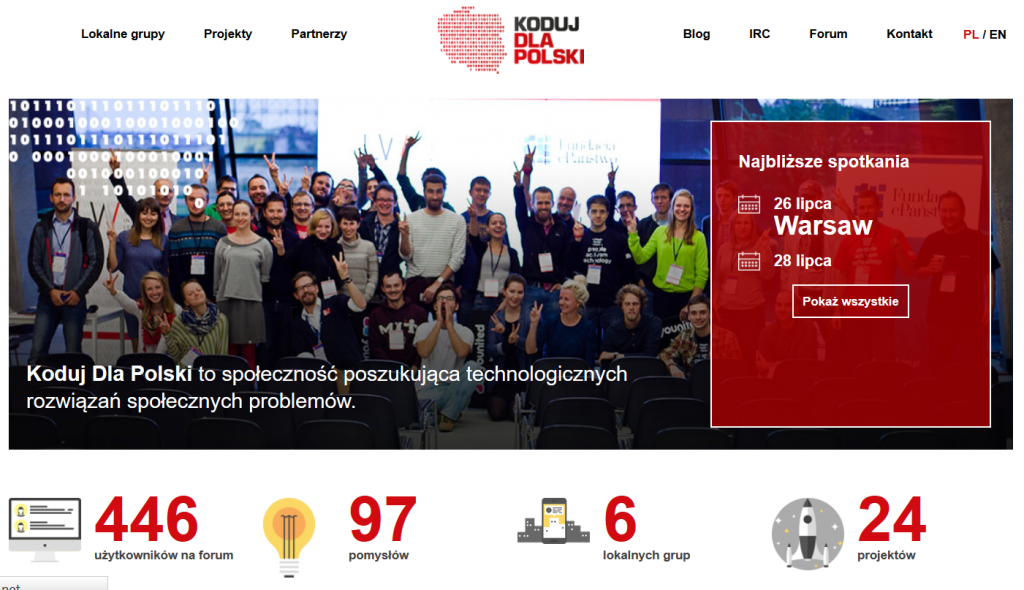
Code for Poland is an interdisciplinary community seeking technological solutions to civic challenges.
Their vision is Poland as a country with efficient public institutions that are citizen-centric, companies focused on social issues operating on public data, progressive NGOs knowing how to advocate with data, with citizens involving themselves more in public matters and finally with dialogue that builds trust among all of these actors.
They strongly believe that a wise use of technology may help to achieve these goals. They work on three areas of action:
- Advocate – creating dialogue with public institutions and NGOs, recommending them progressive open solutions like open data platforms and publishing procurement info, stimulate integration with various partners.
- Create – building innovative social prototypes, applications and services. Repeating successes with deployment in other cities/areas.
- Discuss – participating in discussions on their forum, on conferences. Proposing new ideas, debate ones published by others.
|
| Urban Co-Governance |
Strong |
| Enabling State |
Moderate |
| Pooling |
Moderate |
| Experimentalism |
Moderate |
| Tech Justice |
Moderate |
| Website |
https://codeforpoland.org/cities/warszawa/ |
| References, sources, contact person(s) |
Websites ;
Facebook page : https://www.facebook.com/KodujDlaPolski/
Contact : kontakt@kodujdlapolski.pl |
Warsaw