Yokohama – Smart City Project

Yokohama – Smart City Project

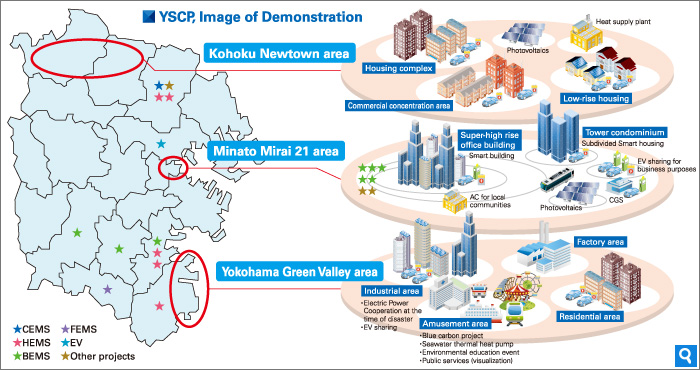
Credits: picture from http://www.city.yokohama.lg.jp/ondan/english/yscp/
Country Japan
City Yokohama
Name Yokohama Smart City Project
Date 2010
Description Yokohama Smart City Project (YSCP) aims to build a smart city having the ability to support the mass introduction of renewable energy as well as to ensure the stable energy supply across the municipal area even in time of crisis.

More specifically, the Yokohama Smart City Project is a five-year pilot program with a consortium of seven Japanese companies – Nissan Motor Co., Panasonic Corp., Toshiba Corp., Tokyo Electric Power Co., Tokyo Gas Co., Accenture’s Japan unit and Meidensha Corp.

In 2010, the City of Yokohama formulated the Yokohama Smart City Project (YSCP)to run in three Yokohama city districts and it has since been deployed to the entire city with a project area covering about 435 km2. The project applies smart grids for the energy management of households, buildings and local communities, introduces large scale renewable energy, and promotes next generation transport systems in order to demonstrate new urban management forms. The project’s mission is to establish a social system that can sustainable develop in an already established city.

In order to achieve this, the city introduced a Community Energy Management System (CEMS) to achieve efficient energy management by linking each EMS, such as in homes and buildings, and stationary energy storage. Specific goals include:

  • Introduction of EMS for 4,000 homes to achieve 20 percent energy reduction.
  • EMS for offices and commercial buildings to control and reduce peak energy consumption by 20 percent.
  • EMS for factories.

In addition, the city will provide 2,000 electric vehicles and charging stations for the transport sector. The use of renewable energy sources is also a priority for the city, as is an effort to change the way citizens relate to energy use. Solar power generation in 249 locations, wind power generation in 2 locations, hydropower generation in 3 locations, and biomass power generation in 6 locations will be implemented. In addition, consumers will receive incentives to limit electricity use, thus contributing to the reduction of CO2 at a lower social cost.
Finally, citizen participation is key to the success of YSCP. For example, the Yokohama Eco School project (YES) was developed to increase citizen participation in YSCP and educate citizens about climate change through lectures, events and workshops. In 2012, 418 lectures were held for 35,000 participants and 121 partner organizations. This led to an increased number of Home Energy Management Systems (HEMS) installed in homes, as well as PV generation systems and storage batteries. Additionally, 4,000 households participated in the FY2014 demonstration project, showing high level of public spirit and making YSCP one of Japan’s largest energy saving projects to date.

Urban Co-Governance Weak
Enabling State Moderate
Pooling Strong
Experimentalism Moderate
Tech Justice Moderate
Project Website http://www.city.yokohama.lg.jp/ondan/english/yscp/

http://www.smartecocity.com/japan/yscp/

http://www.c40.org/profiles/2014-yokohama

References, sources, contact person(s) Websites

To contact in Japanese only : ss-seisaku@city.yokohama.jp

Or in English : callcenter@city.yokohama.jp


yokohama

Timisoara – Ambasada

Timisoara – Ambasada


Source: Ambasada http://www.plai.ro/ambasada/
Country Roumania
City Timisoara
Name AMBASADA
Date 2007 (officially 2014, official opening 2015)
Description The project Ambasada was born in 2007 in Rumania in order to create a space where collaboration between organizations, guilds, crafts and many other people could be encouraged. Free facilities and spaces allow anyone to set up a project, training, event. It is a brand under the CASA PLAI Association, a social enterprise developed in 2014 with the support of NESsT Romania Foundation, part of the European Project “Sprijin integrat Structurilor de Economie Sociala (SISES)”,which helped to make the project concrete. Space represents a resource for work, meetings and events, but also an atmosphere that stimulates and nourishes creativity and initiative, since it has a bistrot too.
Urban Co-Governance Moderate
Enabling State Weak
Pooling Moderate
Experimentalism Weak
Tech Justice N/A
Website http://www.plai.ro/ambasada/despre.html
References, sources, contact person(s) Website

Contact : ambasada@plai.ro


Splaiul Peneș Curcanul nr. 4-5
Timișoara, Romania

Sao Paulo – FLM

Sao Paulo – FLM


Source: Vice https://www.vice.com/pt_br/article/mgq4b8/a-flm-ocupou-16-predios-em-sao-paulo
Country Brazil
City Sao Paolo
Name FLM – Front in the Struggle for Housing – Squatters/ Right to the city/ gentrification victims
Date 2003
Description The FLM is a movement created in 2003, reaching around 80 thousand members. It looks like the Movement of Homeless Rural Workers (MST), but which acts in urban areas. The movement aims to map abandoned properties in the downtown area in order to occupy them. Differently from European movements, Brazilian squats involve families of low-income workers and also immigrants who want to establish themselves in the country. In the centre of Sao Paulo there are over 60 buildings occupied, where cultural centers are built too.

This movement is very important because it stands for a direct and efficient response to the effects of gentrification.

Urban Co-Governance Moderate
Enabling State Weak
Pooling Moderate
Experimentalism Moderate
Tech Justice Weak
Project Website http://www.brasilwire.com/brasils-autonomous-housing-movement/
References, sources, contact person(s) Website

Sao Paulo

Utrecht – Migration and Integration

Utrecht – Migration and Integration


Source image and logo: Utrecht University
https://www.uu.nl/en/organisation/sociology/research/immigration-and-integration
Country Netherlands
City Utrecht
Name Migration and Integration team
Date
Description This research examines the integration of immigrants and their children in Western countries, focusing on “structural” (studying ethnic inequality in the labour market and the underlying causes) and “social-cultural” ( as inter-ethnic attitudes, ethnic polarisation, radicalisation, anti-immigration voting behaviour, ethnic segregation of networks and language acquisition and religion) aspects of integration. Integration is compared amongst multiple ethnic minorities and in numerous host countries, using longitudinal studies too for a better comprehension of dynamics of integration. In this way, the research focus area has two innovative features.
Urban Co-Governance Weak
Enabling State Moderate
Pooling Moderate
Experimentalism Moderate
Tech Justice N/A
Website https://www.uu.nl/en/organisation/sociology/research/immigration-and-integration
References, sources, contact person(s) Website

Contact : Thomas Martens MSc; Knowledge Valorisation Officer at Utrecht University : t.a.m.martens@uu.nl

Utrecht

Milan – Participatory Budgeting

Milan – Participatory Budgeting


Image credit : Screenshot-2022-04-28 and image from https://www.bilanciopartecipativomilano.it/
Country Italy
City Milan
Name Participatory Budgeting
Date 2015
Description The first edition (2015) of the Milan Participatory Budget was realized in collaboration with the Institute for Social Research, Urban Adventure, ARCI Milan and ACLI Milan. The process was organized in three phases: diffusion and outreach; co-working (this phase was structured in 9 laboratories, one per city zone, and involved 30 participants per city zone, extracted from the 700 submission presented by citizens at the end of the first phase; online voting phase. The ouput of the process was rich: each District implemented two projects, except for District 4 and 9, whose implemented only one (16 projects in sum). Every project is composed of several interventions (78 projects in sum). The projects are focused on public space, requalification of public buildings such as schools, squares and parks.  

An updated version of the participatory budget was implemented in 2016[1]. With the path “From the idea to the city”, launched by the City Council under the proposal of the Deputy Mayor to Participation, Active Citizenship and Open Data. The participatory budget is implemented as a part of the broader development plan for the peripheries, for promotion of policies of accessibility and enhancement of administrative decentralization. The new version of the process was approved after a public consultation process involving the political and technical bodies of the City of Milan and the nine City Districts. The initiative addresses the whole population living in the City of Milan and anyone who has a continuous relationship with the city territory for study, work or residents (the so-called city users), starting from the age of 16 and of any nationality. The process is now composed of four phases: reachout and dissemination, co-working; voting; monitoring of the projects. On the institutional platform www.budgetpartecipativomilano.it), urban inhabitants will be able to monitor the different projects funded and see their state of advancement. The project also provides an “Accessibility bonus”, and a City District bonus. The projects that respect the urban accessibility principles will receive an additional 10%, and the projects that accomplish with the District’s needs will also receive an additional 10%. This new version of the participatory budget[2] was realized in collaboration with the University of Coimbra, The University of Milan and the Opensource company and is run through the experimental digital platform Empatia, designed for supporting participatory and collaborative decision making processes: http://www.progettoempatia.it/.

[1] The institutional platform developed for the project is available at the following address: https://www.bilanciopartecipativomilano.it/.

[2]  City of Milan, Resolution of City Government, Approval of Guidelines for the experimental implementation of Participatory Budget 2017, through a collaboration agreement with the University of Coimbra , University of Milan and the Open Source Society for the use of the Empatia Digital Platform,  N. 983 of June 1, 2017.

Urban Co-Governance Moderate
Enabling State Strong
Pooling Moderate
Experimentalism Moderate
Tech Justice Moderate
Website https://www.bilanciopartecipativomilano.it/
References, sources, contact person(s) Interview to Lorenzo Lipparini, Deputy Mayor for Active Citizenship, Participation and Open Data of the City of Milan; institutional materials; Participedia Voice on Milan Participatory Budget: http://participedia.net/en/cases/conto-partecipo-scelgo-il-bilancio-partecipativo-del-comune-di-milano-milan-participatory.
https://www.sharingcities.eu/eurocities/documents/Participatory-Budget-in-Milan-WSPO-AY7CMC
Contact : staffmilanopartecipa@comune.milano.it


milan