by benedictaquarcoo | Lug 17, 2023
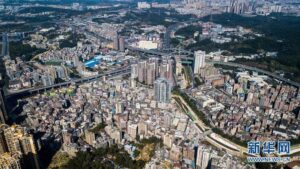
Source credit : https://www.chinadailyhk.com/article/340747 (PHOTO/XINHUA)
| Location |
Guangzhou, Guangdong province, southern China |
| Name |
Flora Village Shareholding Company |
| Date Initiated |
1997 |
| Shared or Co-Governance |
Land expropriation in Flora village took place between 1997 and 2002. When the process started in 1997, the village committee set up a collective property company to manage land contracts and real estate rentals. The collective property company later evolved into a shareholding company that distributes shares to the villagers exclusively.
The shareholding company board members are former village cadres. The former village cadres were directly elected by villagers. The villagers participate actively in electing board members and the company’s decision-making process. |
| Relationship to State |
The village was granted urban administrative status in 2002, and all Flora villagers were granted urban household registration in the same year.
The staff members of the residents’ committee are also former village cadres. However, there is no overlap between these staff members and the shareholding company board members.
Since the shareholding company is the major financial supporter of the residents’ committee, the company could decide its own development plans and the way it spends its money, without taking into consideration the opinions by the residents’ committee. |
| Pooling of Social and Economic Resources |
By 2002, the Flora village kept about 30 percent of the village’s collectively-owned cultivated land. The 3,000 Flora villagers also kept their house sites.
The village shareholding company manages the village’s industrial zone on its retained land, which hosts three medium-sized factories and nearly 20 small workshops. The company also rents out property to the villagers, enabling them to run restaurants, hairdressers, grocery stores, and internet cafes. |
| Local Need(s) or Services Provided |
Using rental income from the 30-percent retained land, the shareholding company provides collective welfare to Flora villagers. In 2011, every shareholder received 1,500 yuan on average, with older villagers receiving as high as 7,000 yuan. The company also provides subsistence allowances for the elderly who can no longer make a living, as well as a monthly livelihood subsidy of 150 yuan to all villagers who have reached the age of 60.
In addition, the company makes deals with new firms built on the village land to give priority to local villagers when filling job vacancies to help unemployed residents find jobs.
The shareholding company has also been subsidizing administration expenses and community services, spending about a quarter of its annual income on community infrastructure, policing, and sanitation. For example, in 2009, it spent a million yuan renovating a local primary school and a community park, even though the school and the park were not exclusive to the villagers.
Also, the company has collaborated with the residents’ committee to address the increasing safety concerns, by hiring security guards from among the young villagers to work in the neighborhood.
Finally, given the company’s rich knowledge of local people and culture as well as its extensive social networks within the community, it plays a key role in mediating conflicts between the residents. |
| Digital Infrastructure, Open Data, Other Aspects |
N/A |
| Comments |
The villagers perceive the company as the extension of their old village committee and thus, as the authority in the community, rather than the residents’ committee.
The company is facing the challenge of upgrading the low-tech, highly polluting factories it hosts on the village’s retained land, to better compete in the increasingly fierce market competition and meet the higher expectations from the villagers. Thus, the company is eager to withdraw from the services and financial support it is providing for the whole community. It wants to focus on upgrading industries and offer exclusive benefits to its shareholders, i.e. villagers. |
| References and Sources |
Chung, H., & Unger, J. (2013). The Guangdong model of urbanisation: collective village land and the making of a new middle class. China Perspectives, 3, 33–41.
Tang, B. (2015). “Not Rural but Not Urban”: Community Governance in China’s Urban Villages. The China Quarterly, 223, 724–744. |
Village shareholding companies-1997-Urban Villages- Village Shareholding Companies in China-Flora Village Shareholding Company

by benedictaquarcoo | Lug 14, 2023

| Location |
Buenos Aires, Argentina |
| Name |
Club Cultural Matienzo |
| Date Initiated |
November 2008 |
| Shared or Co-Governance |
In legal terms Matienzo is a collective project of private capital (social business), supported by an NGO. The local community and many social innovators and active citizens are also involved in the governance of the Club. |
| Relationship to State |
One of the co-founders of the Club affirms that they are “in a continuous fight with the local government”. This was certainly true at the beginning of their adventure, when the local government used to close down those centers. The Club, through the Abogados Culturales NGO, has promoted a law, that is passed but is not applied by the government. The club derives the 5-8 % of its budget from the public funds. |
| Pooling of Social and Economic Resources |
The people working in the project own and directly manage the Club. The CCM involves its members and users in the contents production phase. From the beginning the team has focused on identifying social challenges, organizing meetings and networks in which to exchange ideas and examples of best/good practices, and collaborating towards the generating solutions. The CCM works together with other cultural centers of the city to solve many problems that affect such initiatives. They buy supplies together and work together to produce festivals. |
| Local Need(s) or Services Provided |
The CCM has identified the culture and the arts as a local need. The CCM started to involve answers to the issue of the urban poverty in its activity through an empowerment of the artists and the cultural managers that are inhabitants of the city. This empowerment is achieved through the development of a sustainable cultural ecosystem. In facts, by pursuing justice in creative and economic conditions for all the actors involved in the project and through the benefit/possibility that the Club offers to the ones that want to contribute and be part of the governance structure of the Club (a benefit that derives from the personal growth and from the acquirement of the tools of a cultural manager) they have succeeded in creating better economic and social conditions for many |
| Digital Infrastructure, Open Data, Other Aspects |
The club uses technological tools just to communicate its initiatives and has launched a workshop dedicated to the “Digital Tools for Personal Organization”21. |
| Comments |
\ |
| References and Sources |
|
Argentina, Buenos Aires-Club Cultural Matienzo-2018-

by Staff | Lug 7, 2022

Image credits : seoulmaeul.org

by Staff | Mag 11, 2022

Image source: https://www.urbandreambrokerage.org.nz/
| Country |
Australia |
| City |
Wellington |
| Name |
Urban Dream Brokerage |
| Date |
2012 |
| Description of the project |
After a trial in 2012, the service was launched in Wellington and eventually three other urban centres around New Zealand.
“Urban Dream Brokerage provides space for new ideas from artists, creatives and social practitioners in our cities.
Working with property owners, managers, artists, individuals and community groups UDB brokers the temporary use of space, be it public or commercial, empty or underutilised for innovative projects, assisting in urban revitalisation. As of 2020 UDB had brokered space for over 120 projects with more than 40 property owners, big and small, assisting them with keeping their properties cared for and dynamic as they seek tenants. ” (https://www.urbandreambrokerage.org.nz/about)
|
| Urban Co-Governance |
Moderate |
| Enabling State |
Weak |
| Pooling |
Strong |
| Experimentalism |
Strong |
| Tech Justice |
Weak |
| Project Website |
https://www.urbandreambrokerage.org.nz/ |
| References, sources, contact person(s) |
Questionnaire, website
Contact : Linda Lee Linda@urbandreambrokerage.org.nz |
Wellington

by Staff | Mag 11, 2022
 Image source: https://www.carnextdoor.com.au/
| Country |
Australia |
| City |
Sydney
|
| Name |
Car Next Door |
| Date |
2012 |
| Description of the project |
Born to help solve the issues associated with underused vehicles, Car Next Door was the first peer-to-peer car share network in Australia. People aren’t going to give up owning cars unless there is some really convenient, money-saving alternative. Car Next Door gives people the “mobility-possibility”of having a car nearby when you need it, at a much lower cost than owning one. Neighbour to neighbour (or “Peer to Peer”) car sharing, according to the main definition, is a form of car sharing that allows car owners to convert their personal vehicles into share cars that can be rented to other drivers on a short-term basis.
All these realize an on-demand service usable by the communities, that can help to resolve the one-person one-car mentality, that conduct to the main problems related to city mobility, like pollution, traffic and car parking problem.Car Next Door was started as a way for neighbours to rent out their cars to people in their community –empowering them to reduce waste and create cleaner, greener, better neighbourhoods.
It works in Sydney –Brisbane -Melbourne. |
| Urban Co-Governance |
Weak |
| Enabling State |
Weak |
| Pooling |
Strong |
| Experimentalism |
Moderate |
| Tech Justice |
Weak |
| Project Website |
https://www.carnextdoor.com.au/ |
| References, sources, contact person(s) |
Questionnaire, website
Other references :
https://www.youtube.com/watch?v=hTrXOQoRuWI
https://blog.carnextdoor.com.au/
https://www.crunchbase.com/organization/car-next-door
David Swan (2018),Major players driving the Car Next Door,The Australian,LexisNexis Academic.-Davis Swan (2018),Car Next Door joins Hyundai in $2m sharing deal, The Australian, LexisNexis Academic.
Contact : info@carnextdoor.com.au |
Sydney