Detroit – Live 6 Alliance

Detroit – Live 6 Alliance

Detroit – Live 6 Alliance
Credits: Picture by http://www.live6detroit.org/#storiesintro
Country United State
City Detroit
Name Live 6 Alliance
Date 2015
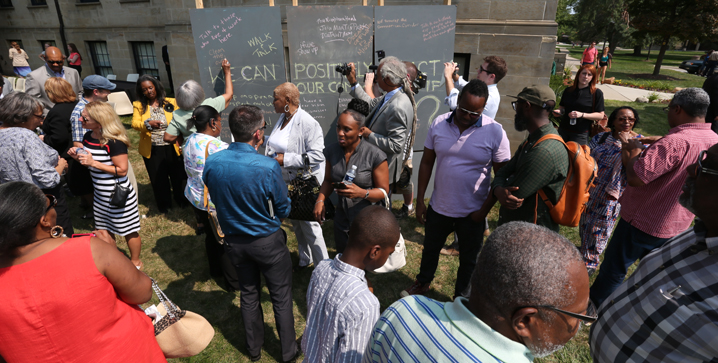
Description Live6 Alliance is a nonprofit planning and development organization whose mission is to enhance quality of life and economic opportunity in Northwest Detroit. It was formed in 2015 through a partnership of community, philanthropic and city stakeholders led by the University of Detroit Mercy.

Live6 Alliance strives for authentic, inclusive neighborhood revitalization with a particular focus on the Livernois and McNichols corridors. The organization serves a central convener and coordinator between the community, institutions, and key stakeholders who contribute to positive change in the community.

The organization actively serves the community in the following six program areas:

  1. Real estate development
  2. Business attraction & retention
  3. Placemaking
  4. Residential stabilization
  5. Safety
  6. Engagement
Urban Co-Governance Strong
Enabling State Strong
Pooling Strong
Experimentalism Strong
Tech Justice –
Website http://www.live6detroit.org/#intro
References, sources, contact person(s) Interview with Lauren Hood, Website

Live6 Facebook Page: here.

“New Live6 Alliance Executive Director and Commercial Corridor Manager named,” Detroit Mercy, February 8, 2018, available here.

“With democratic budgeting, Live6 takes a nontraditional approach to community engagement,” Model D, “Features,” December 17, 20717, available here.

“New Live6 Alliance headquarters and its homegrown director bring energy to neighborhood,” Model D, “Features,” October 10, 2016, available here.

“New effort to spruce up Livernois and McNichols area,” Detroit Free Press, August 31, 2015, available here.

Contact : info@live6detroit.org

detroit

7426 W. McNichols

Detroit, MI 48221

Villadecans – VILAWATT -Innovative Local Public-Private-Citizen Partnership for Energy Governance

Villadecans – VILAWATT -Innovative Local Public-Private-Citizen Partnership for Energy Governance


Source: Viladecans, http://www.viladecans.cat/es
Country Spain
City Villadecans
Name VILAWATT -Innovative Local Public-Private-Citizen Partnership for Energy Governance
Date 2016
Description The main challenge is to achieve a low carbon, socially just, healthier and happier community, where citizens play an active role in that change in order to secure a stable Energy Transition Process in Viladecans City.

From all the challenges that a community must face in an energy transition process, VILAWATT will, as a priority, focus on unlocking the needed deep energy renovation of residential buildings. The proposal aims at addressing this situation firstly in low income communities where higher efforts need to be done (In Spain about 17% homes are suffering from fuel poverty).

This project will initiate the transition by focusing on Montserratina District (45 Ha.) with its 20.216 residents (30% of the whole City), 8.026 dwellings (6.203 of which are built before 1976, i.e. before any energy related legislation was in place). The annual district income is 15% lower compared to the City average, and its annual final energy consumption is 34 GWh; 75 kWh/year m2.

On a social, economic and environmental level this project works to:

  • Awake the community on the energy efficiency and management, and will empower the citizens by making them transit from a passive to a proactive role.
  • Strengthen the local economy by bringing economic empowerment to the community vulnerable groups and by creating new jobs linked to the energy transition.
  • Reduce environmental impacts (GHG, air pollution and other) thanks to energy efficiency measures and the switching from fossil fuels to renewable energy. VILAWATT pretends to reduce these impacts gradually and in a stable way, instead of having an occasionally benefit.

The Energy Transition will be initiated by the creation of an Innovative Public-Private-Citizen Governance Partnership at Local level (PPCP). This new PPCP will be the central hub that will manage the new local tools for the transition: energy supply, energy currency, energy savings services, deep energy renovation investments and renewable energy production.

This entity will have, for the first time, the Municipality together with the local businesses and the citizens of Viladecans as its members. Its mission will be to promote and ensure a secure, clean and efficient use of energy.

Urban Co-Governance Moderate
Enabling State Strong
Pooling Strong
Experimentalism Strong
Tech Justice Moderate
Website https://www.viladecans.cat/en/vilawatt
References, sources, contact person(s) VILAWATT -Innovative Local Public-Private-Citizen Partnership for Energy Governance, Villadecans, Spain. Source: website, and http://www.uia-initiative.eu/en/uia-cities/viladecans
Contact :

Marina JARQUE
Corporate Communications and International Relations Director

Viladecans, Spain

Valencia – Civic Factory

Valencia – Civic Factory


Image Source: Labsus http://www.labsus.org/2016/12/civicwise-
urbanistica-collaborativa-intelligenza-connettiva-e-azione-locale-2/
Country Spain
City Valencia
Name Civic Factory
Date 2016
Description The Civic Factory is an ecosystem of synergies capable of promoting collaborative and collective construction dynamics among the actors of the city,: citizenship, public administration, university and the private sector. An accelerator for initiatives and collective projects capable of transforming the territory.

It was created by the CivicWise Valencia circle belonging to the international network CivicWise and focused on projects of Collective Intelligence, Civic Innovation and Open Design. The Civic Factory proposes a new format for intermediation and promotion of activities, projects, actions and practices of Civic Economy, regardless of discipline, experience, race or condition.

The first phase to be able to prototype this project has been the Civic Factory Fest: a month-long event in which public, private and collective entities from Valencia and other cities in Spain and the rest of Europe have taken a first step towards its collective construction. The scenario and the opportunity to materialize the project was born from the collaboration between CivicWise and the public consortium of La Marina Real of Valencia in which it was designed the reactivation of the area destined to the hangars of the Alinghi building. From this first prototyping, it was established a community of people willing to go ahead with the project.

Urban Co-Governance Moderate
Enabling State Moderate
Pooling Moderate
Experimentalism Moderate
Tech Justice Weak
Website Factoría Cívica Valencia (civicwise.org) : https://factoriacivicavalencia.civicwise.org/
References, sources, contact person(s) Civic Factory, Valencia Spain. Source: Institutional website;  Demo Comunes.net http://democomunes.net/civic-factory-fest-espacio-para-la-construccion-colectiva-de-la-ciudad/

Contact : valencia@factoriacivica.com

Valencia, Spain

Utrecht – Human Rights Cities

Utrecht – Human Rights Cities

Source: University of Utrecht https://www.uu.nl/masters/en/biofabrication/why-utrecht
Country Netherlands
City Utrecht
Name Human Right Cities
Date 2010
Description In 2010, the City of Utrecht adopted the universal standard of human rights to guarantee a high quality of life for all inhabitants. According to this aim, Utrecht has been working on promoting a human rights culture in the city, fitting the identity of an open, inclusive and social city. In 2013, a Local Human Rights Coalition was born, consisting of NGOs, local civil society organizations, businesses, politicians, policy officers and scientists. The Coalition’s aim is to create awareness and ownership of local human rights in order to enhance the quality of life of citizens by translating global value(s) into the local practices. Although the initiative does focus on this local bottom-up governance approach, best practices are shared with other cities at the national and international level.

This innovative project involves a partnership, and actually the partnership itself is one of the innovative elements. The partnership has the structure public-community-private. So far, the leading partner, or better, the facilitator, is the City of Utrecht. However, the coalition is increasingly horizontally structured, with the city of Utrecht becoming more and more a member of the coalition like the others. Therefore, the ‘leading’ role can better be seen as ‘facilitating’ role. Since the coalition is unique in the Netherlands, several national organizations (ministries, Dutch association of Municipalities, the Ombudsman, researchers, the national human rights institute)  are supporting the initiative, in addition to the local partners.

In practice, this framework has organized the following initiatives:

Cultural Programme / Vrede van Utrecht

Since the local human rights program (http://www.vredevanutrecht2013.nl/) in particular has a cultural objective, over time, much attention has been given to a cultural program that translates and supports the idea of a local human rights culture. For this purpose, a special program was developed in 2013, focusing on local and international peacemaking inspired by the 300th anniversary of the Treaty of Utrecht. In many cultural expressions, such as exhibitions, theatre, symposia, widespread attention was given to the local awareness of the importance of human rights and the importance of inspiration for recognizing human dignity.

Week of local democracy and human rights

To mobilize numerous local human rights organizations and bring them into contact with each other, Utrecht have been working on the annual week of local democracy and human rights (an initiative of the Council of Europe) under the title of ‘Human Rights: What about your backyard?’. Local organizations opened their doors to the public these weeks and offered special meetings to inform the general public about their activities. The promotion of the program was centrally facilitated, inter alia through a website and a widespread activity calendar. Because of its innovative approach Utrecht became the title of the European ‘12 Star City’ .

Human Rights Café’s

As mentioned before, one of the objectives is to give a platform to organizations and actors to discover crossovers. Therefore, an important feature of the process is to facilitate the emergence of a group and to create opportunities for the organizations in the city to meet each other, with the aim to extend and strengthen the network and thus to extend the fundament for a local human rights culture. One way this is facilitated by organizing human rights cafés four times a year. These cafés are a great way for organizations to network and explore crossovers. The cafés are also important in enhancing the use of the human rights narrative by organizations. No less than four hundred organizations are actively invited to the cafés, but of course they are accessible to all those interested.

Urban Co-Governance Strong
Enabling State Strong
Pooling Moderate
Experimentalism Moderate
Tech Justice –
Website Utrecht – HRCN (humanrightscities.net)
References, sources, contact person(s) Human Rights Cities Utrecht, Netherlands. Source: Interview to Hans Sakker, Head of Department of European and International Affairs, City of Utrecht

Contact : https://humanrightscities.net/contact-us/

Utrecht

Voi – Community Land Trust

Voi – Community Land Trust

Source: Photos Tell Stories https://photostellstories.org/2015/03/11/photo-of-the-day-women-of-community-led-total-sanitation-nigeria/
Country Kenya
City Voi
Name Community Land Trust – Voi
Date End of the 1990’s
Description of the project The Community Land Trust in Voi experiment is the first of its kind in the country.  Colonial policies did not allow for an African to own land in urban areas. African workers were settled on the peripheries of urban areas – within the ‘native reserves’ and were granted a Temporary Occupation Licence (TOL) that rendered them tenants at will of the state with no right to build permanent structures. Hence Africans could only build temporary structures using traditional materials like wood and clay with grass thatch or tin roofs. This has continued into the 1990s and the poor who continue to settle on the edges of the towns are still treated as temporary occupants or ‘squatters’. Hence the issue of security of tenure becomes important beyond mere access so that people can build and own homes and develop communities rather than live like refugees in their own cities and towns.

Government is now being encouraged to reconsider its land tenure policy in the light of the CLT experience in Voi and to expand creative thinking in the area of land tenure policy based upon an African perspective of land tenure that benefits the community rather than just the individual.

Urban Co-Governance Strong
Enabling State Moderate
Pooling Moderate
Experimentalism Moderate
Tech Justice Moderate
Project Website http://www.sciencedirect.com/science/article/pii/S0264837713000872

http://www.hic-gs.org/document.php?pid=2548

References, sources, contact person(s) Emmanuel Midheme, Frank Moulaert. “Pushing back the frontiers of property: Community land trusts and low-income housing in urban Kenya”, Land Use Policy, Volume 35, 2013.

Jaffer Murtaza, The Tanzania-Bondeni Community Lands Trust, Voi, Kenya. Habitat International Coalition. 1996.

Website           http://www.sciencedirect.com/science/article/pii/S0264837713000872

http://www.hic-gs.org/document.php?pid=2548

Voi