by Francesca Spigarolo | Giu 8, 2018
© Geef om Jan Eef
| Country |
Netherlands |
| City |
Amsterdam |
| Name |
Ik geef om de Jan Eef |
| Date |
2010 |
| Description |
Ik geef om de Jan Eef (I care about Jan Eef) is a project through which local residents managed to regenerate a commercial street in a difficult neighborhood of Amsterdam. A group of residents and local entrepreneurs got together in an association and created a “Company Investment Zone” where shop owners join a fund in order to maintain the street themselves. The area is also, thanks to the support of the local administration, a free zone, where municipal rules for entrepreneurs and shop owners are less strict.
The association mediates between buildings owners and entrepreneurs in order to decrease the number of vacant buildings, and select projects which could bring an added value to the neighborhood. Through the Jan Eef project a local market has been created, and buildings are never empty, as many pop up shops and offices are put in place thanks to association’s coordination activity. |
| Urban Co-Governance |
Moderate |
| Enabling State |
Strong |
| Pooling |
Moderate |
| Experimentalism |
Strong |
| Tech Justice |
Moderate |
| Website |
http://www.geefomdejaneef.nl/over-jan-eef/jan-evertsen-buurtcooperatie/ |
| References, sources, contact person(s) |
Website ;
https://citiesintransition.eu/place/geef-om-jan-eef
Interview, Pakhuis De Zwijger
Contact : wsvjaneef@gmail.com |
jan eef
by Francesca Spigarolo | Giu 8, 2018

Image Credit : https://buiksloterham.nl/ and https://studioninedots.nl/project/cityplot-buiksloterham/
| Country |
Netherlands |
| City |
Amsterdam (neighbourhood buiksloterham) |
| Name |
Buiksloterham |
| Date |
2005/2006 |
| Description of the project |
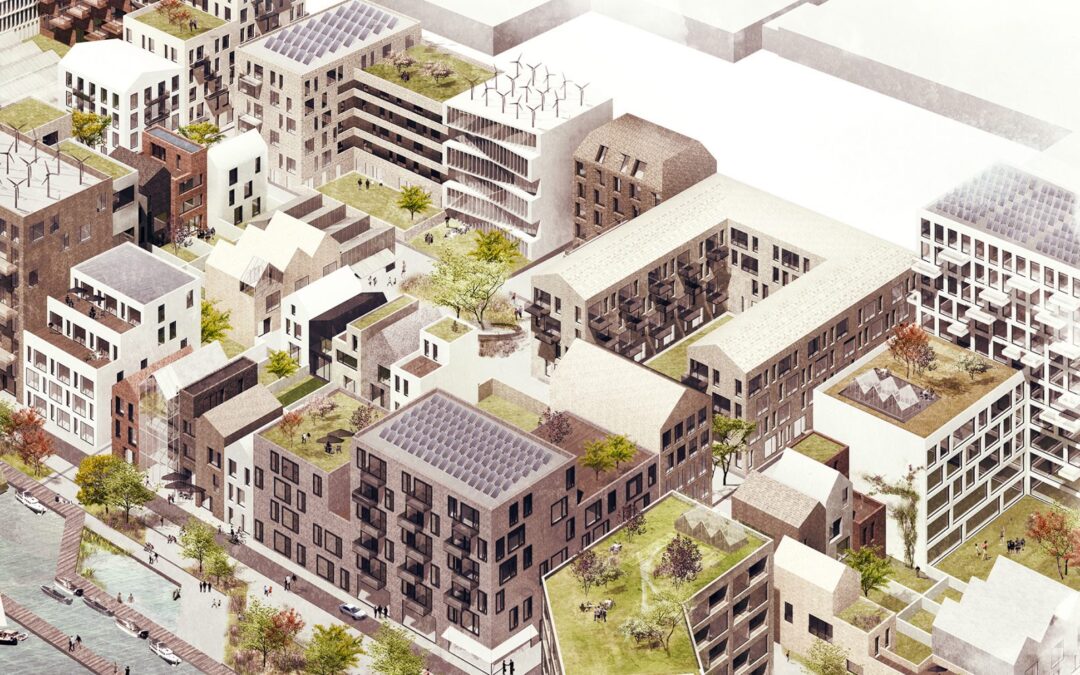
Buiksloterham used to be the industrial district of Amsterdam, which was slowly abandoned by the companies who produced there, resulting in a polluted wasteland.
Around 10 years ago the Municipality decided to regenerate the area adopting an organic approach: the zoning was changed to allow for mixed uses, and the development of shared offices and housing solutions was favoured. Citizens were involved in the process, architects and designers were called to design the offices and, as the Municipality didn’t have enough resources (because of the 2008 crisis) land was given through a ten-years lease to entrepreneurs proposing an innovative and sustainable urbansim project. This led to the creation of floating houses connected by wooden walkaways who keep pedestrians away from the polluted soil, which is being cleaned by special plants, in an area centered around green energy.
The Municipality also sold of housing lots at low prices nearby, allowing citizens to design their own sustainable houses.
The nieghbourhood has become a growing circular economy district, with its own Manifesto. |
| Urban Co-Governance |
Moderate |
| Enabling State |
Strong |
| Pooling |
Moderate |
| Experimentalism |
Moderate |
| Tech Justice |
Weak |
| Project Website |
http://buiksloterham.nl/ |
| References, sources, contact person(s) |
Source :
Website ;
http://citiscope.org/story/2016/how-amsterdam-turned-polluted-industrial-site-its-most-interesting-neighborhood ;
Architecture studio Studioninedots at https://studioninedots.nl/project/cityplot-buiksloterham/
DELVA Landscape Architects : https://delva.la/projecten/buiksloterham/One of the architect : Steven Delva steven@delva.la |
Buiksloterham

by Chiara De Angelis | Giu 8, 2018
 Image source : https://prinzessinnengarten.net/
| Country |
Germany |
| City |
Berlin |
| Name |
Prinzessinnengarten (Princess Garden) |
| Date |
2009 |
| Description |
Prinzessinnengarten (Princess Garden) was created on an abandoned plot of land which for decades had been used as a wasteland. The regeneration process was activated by the non-profit Nomadisch Grüne and, thanks to the participation of local residents and activists, resulted in the creation of a social-urban-agricultural venture. The garden is not only a place where to grow vegetables, but has instead become a platform for people of the nieghborhood where it is possible to relax in an open space, go to the restaurant or to the café, see art exhibitions and music performances, attend formal and informal workshops, and much more. The place also functions as a social enterprise which currently employs 12 people.
Since 2015 a knowledge and experience creation process has been activated by The Neighborhood Academy, a self-organized open platform for urban and rural knowledge sharing, cultural practice and activism. The Academy is engaged on topics such as Local and global exchange between urban and rural communities, Commons, Right to the city, Socio-ecological transformation from the bottom-up, Self-organized learning and much more. Working with numeorus partners the Academy is currently focusing on projects such as The Arbour – A self-build experimental architecture in Prinzessinnengärten, which will serve as an open space for learning and exchange, MAZI – building local, community wireless networks, ZUsammenKUNFT – a pilot project on living and working with refugees, Moritzplatz Futures – a long-term neighbourhood oriented, social and ecological development of the site at Moritzplatz in Berlin-Kreuzberg. |
| Urban Co-Governance |
Moderate |
| Enabling State |
Moderate |
| Pooling |
Moderate |
| Experimentalism |
Moderate |
| Tech Justice |
N/A |
| Website |
https://prinzessinnengarten.net/ |
| References, sources, contact person(s) |
Website, http://www.nachbarschaftsakademie.org/en/programm-2015/
Contact : nachbarschaftsakademie@prinzessinnengarten.net |
berlin

by Lucia Errandonea | Giu 8, 2018

Image source : https://darwin.camp
| Country |
France |
| City |
Bordeaux |
| Name |
Darwin camp – Ecosystème Urbain Darwin |
| Date |
2008 |
| Description |
Darwin was created as an urban ecosystem inside of an old military barrack that was left abandoned in the city of Bordeaux.
The project includes small commerces, a co-working space, shared offices, cultural, artists, and residents’ associations, apiculture activities and urban farms, cafés, bars and restaurants, sports areas, and a hostel among others. The whole system follows a governance model that is collaborative and participatory, thanks to the “Darwiniens” association. It is a sustainable structure as it hosts workshops for the recycling of various materials; it sets up spaces with the help of recycled furniture; it follows an advanced recycling system for the waste produced; and finally, it makes use of renewable energy and collects rainwater. The Darwin project is therefore an example of a sustainable renovation that remains inclusive and fosters community building in the city. |
| Urban Co-Governance |
|
| Enabling State |
|
| Pooling |
|
| Experimentalism |
|
| Tech Justice |
|
| Website |
http://darwin.camp/ |
| References, sources, contact person(s) |
Gancille J.M and Barre P. L’écosystème urbain Darwin. Du Hacking Territorial à un nouveau modèle de coproduction de la ville? Futuribles n° 414 . septembre-octobre 2016
website: http://darwin.camp/
Contact : contact@darwin.camp |
Bordeaux
by Lucia Errandonea | Giu 8, 2018
Credits: Picture by © City Acupuncture, 2017
| Country |
Serbia |
| City |
Belgrade |
| Name |
Savamala Neighborhood |
| Date |
2010 |
| Description |
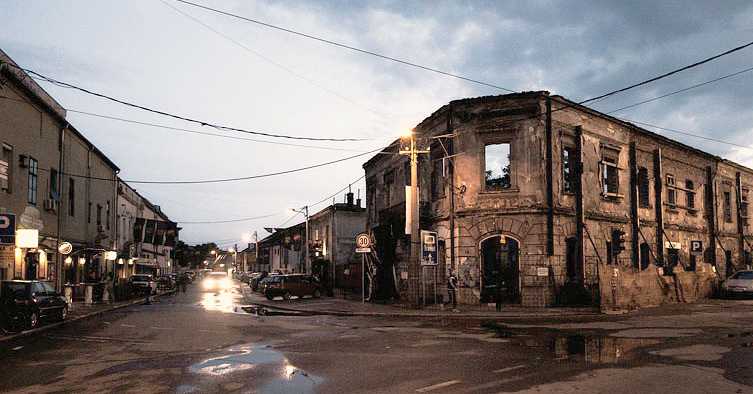
Savamala is a district in the city of Belgrade that in the past 5 years has been experiencing a process of cultural revitalization thanks to local artists, entrepreneurs, and community members. Starting with the founding of the independent art center “KC Grad” in 2012, Savamala witnessed a wave of transformations that turned the district into one of the most active cultural, artistic and music hubs of the city. The many abandoned and decrepit warehouses in the area were renovated and transformed in bars, music venues, art centers and cultural associations. The future of the neighborhood has also been debated among the community thanks to workshops organized by the Goethe Institute, as part of the ” Urban Incubator: Belgrade ” project. Thanks to these discussions and to the input of artists and local community members, the neighborhood continues to go through a process of cultural improvement. |
| Urban Co-Governance |
Moderate |
| Enabling State |
Strong |
| Pooling |
Moderate |
| Experimentalism |
Strong |
| Tech Justice |
Moderate |
| Website |
– |
| References, sources, contact person(s) |
http://edition.cnn.com/travel/article/savamala-belgrade-osm/index.html
https://www.theguardian.com/travel/2015/feb/07/belgrade-savamala-serbia-city-break
http://blog.goethe.de/urbanincubator/categories/3-A-Model-for-Savamala |
Savamala, Belgrade