

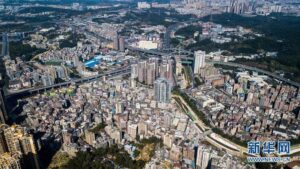
Source credit : https://www.chinadailyhk.com/article/340747 (PHOTO/XINHUA)
| Location | Guangzhou, Guangdong province, southern China |
| Name | Flora Village Shareholding Company |
| Date Initiated | 1997 |
| Shared or Co-Governance | Land expropriation in Flora village took place between 1997 and 2002. When the process started in 1997, the village committee set up a collective property company to manage land contracts and real estate rentals. The collective property company later evolved into a shareholding company that distributes shares to the villagers exclusively.
The shareholding company board members are former village cadres. The former village cadres were directly elected by villagers. The villagers participate actively in electing board members and the company’s decision-making process. |
| Relationship to State | The village was granted urban administrative status in 2002, and all Flora villagers were granted urban household registration in the same year.
The staff members of the residents’ committee are also former village cadres. However, there is no overlap between these staff members and the shareholding company board members.
Since the shareholding company is the major financial supporter of the residents’ committee, the company could decide its own development plans and the way it spends its money, without taking into consideration the opinions by the residents’ committee. |
| Pooling of Social and Economic Resources | By 2002, the Flora village kept about 30 percent of the village’s collectively-owned cultivated land. The 3,000 Flora villagers also kept their house sites.
The village shareholding company manages the village’s industrial zone on its retained land, which hosts three medium-sized factories and nearly 20 small workshops. The company also rents out property to the villagers, enabling them to run restaurants, hairdressers, grocery stores, and internet cafes. |
| Local Need(s) or Services Provided | Using rental income from the 30-percent retained land, the shareholding company provides collective welfare to Flora villagers. In 2011, every shareholder received 1,500 yuan on average, with older villagers receiving as high as 7,000 yuan. The company also provides subsistence allowances for the elderly who can no longer make a living, as well as a monthly livelihood subsidy of 150 yuan to all villagers who have reached the age of 60.
In addition, the company makes deals with new firms built on the village land to give priority to local villagers when filling job vacancies to help unemployed residents find jobs.
The shareholding company has also been subsidizing administration expenses and community services, spending about a quarter of its annual income on community infrastructure, policing, and sanitation. For example, in 2009, it spent a million yuan renovating a local primary school and a community park, even though the school and the park were not exclusive to the villagers.
Also, the company has collaborated with the residents’ committee to address the increasing safety concerns, by hiring security guards from among the young villagers to work in the neighborhood.
Finally, given the company’s rich knowledge of local people and culture as well as its extensive social networks within the community, it plays a key role in mediating conflicts between the residents. |
| Digital Infrastructure, Open Data, Other Aspects | N/A |
| Comments | The villagers perceive the company as the extension of their old village committee and thus, as the authority in the community, rather than the residents’ committee.
The company is facing the challenge of upgrading the low-tech, highly polluting factories it hosts on the village’s retained land, to better compete in the increasingly fierce market competition and meet the higher expectations from the villagers. Thus, the company is eager to withdraw from the services and financial support it is providing for the whole community. It wants to focus on upgrading industries and offer exclusive benefits to its shareholders, i.e. villagers. |
| References and Sources | Chung, H., & Unger, J. (2013). The Guangdong model of urbanisation: collective village land and the making of a new middle class. China Perspectives, 3, 33–41.
Tang, B. (2015). “Not Rural but Not Urban”: Community Governance in China’s Urban Villages. The China Quarterly, 223, 724–744. |
Village shareholding companies-1997-Urban Villages- Village Shareholding Companies in China-Flora Village Shareholding Company